Create Once, Share Everywhere™ (COSE): A Structured Content Framework For Food Creators And PlatformsThe COSE™ framework turns recipes into structured, reusable, multi-channel content assets.
COSE™ (Create Once, Share Everywhere) is Blueberri’s structured content framework for food creators and food tech teams.
Instead of treating recipes as single-use blog posts, COSE treats them as structured data assets that can power blogs, apps,
search, social, voice, and commerce from a single source of truth.
Quick Overview
Problem: Recipes are scattered across blogs, apps, social posts, and partner platforms with no reliable way to keep them in sync.
Opportunity: Treat recipes as structured content so one update can power every channel—from Google Search to smart appliances.
Who COSE Is For: Independent food bloggers, multi-channel creators, and food tech teams who want content systems that scale without burning everyone out.
The core idea behind COSE is simple: structure a recipe once, and use that structure everywhere. In practice, that means
creating a content model, metadata, and systems that allow the same recipe to appear consistently across a blog, mobile app,
Google Search, Pinterest, TikTok, smart appliances, and retailer integrations—without rewriting it from scratch for each
channel.
COSE isn’t a plugin or a single tool. It’s a way of thinking about recipe content as structured data instead of one-off posts.
When you design recipes as data, you can send that data to almost any interface: a search engine, a grocery app, a voice
assistant, or an in-store kiosk. The content becomes more flexible than the layout it’s displayed in.
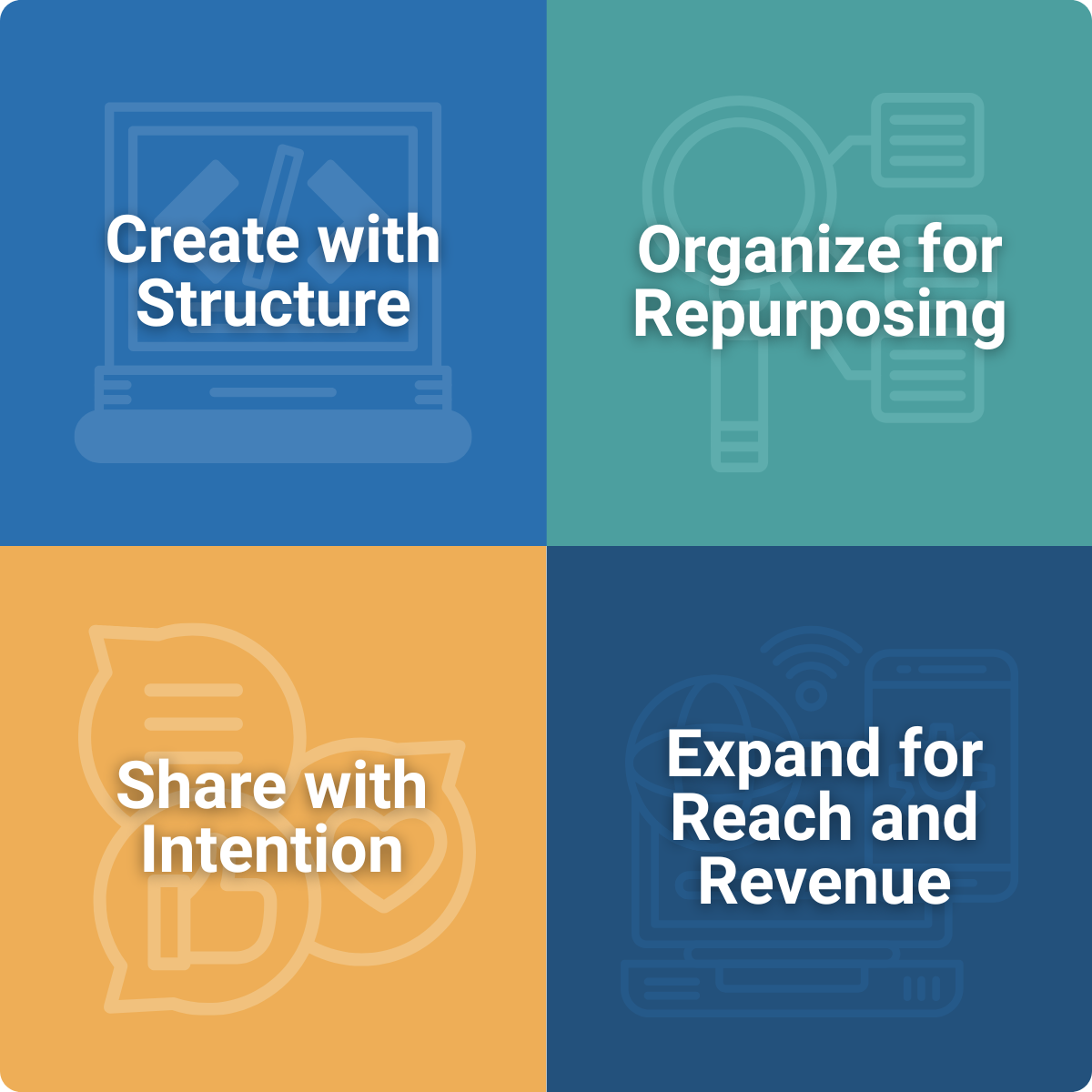
The framework is built around four pillars that work together as a lifecycle:
Pillar 1
Create With Structure
Model recipes as structured content from the beginning: ingredients, steps, times, media, metadata, and schema-ready fields,
so they’re easy to reuse and transform without hunting through long paragraphs of prose.
Pillar 2
Organize For Reuse
Store recipes in a system that makes them searchable, filterable, and ready to be repurposed using taxonomies, tags,
and well-governed metadata—rather than folders, spreadsheets, and memory.
Pillar 3
Share With Intention
Plan where content goes and why. Use templates and transformations that respect the needs of each channel instead of
copying and pasting the same post into every format and hoping it “just works.”
Pillar 4
Expand For Reach And Revenue
Use structured content to unlock new distribution, licensing, and monetization opportunities across food tech partners,
platforms, and products—without rebuilding your entire library each time.
Most recipe workflows were designed for a world where the blog post was the final destination. A creator wrote a post, added a
printable card, hit publish, and moved on. That model doesn’t hold up when the same recipe needs to live in a blog, a mobile
app, an API for partners, a retailer integration, and a TikTok series.
In a traditional setup, every update spawns a to-do list: fix the blog, adjust social captions, refresh the meal-planning app,
resend assets to partners, recheck schema and SEO, and maybe update a newsletter feature later. None of those systems talk to
each other. There is no single source of truth—only copies.
Where Legacy Workflows Fall Apart
Copy-and-paste content between platforms instead of mapping structured fields.
Multiple “final” versions of the same recipe floating around in email, docs, and drafts.
Schema treated as a one-time SEO task instead of an ongoing content asset.
Updates that are trivial in the kitchen but heavy in the CMS and distribution stack.
That friction shows up everywhere. Small teams delay obvious fixes because they don’t have time to update every surface.
Product teams ship new features without clear content requirements. Platform partners ask for “a quick export” that turns into
a week of manual formatting.
Over time, this creates content debt: old posts that can’t be trusted, partner feeds that drift out of sync, and a growing sense
that adding more recipes will only add more chaos. That’s the environment COSE is designed to change.
Note: If you’ve ever hesitated to fix an obvious issue in a high-traffic recipe because of how many places
you’d have to touch, you’ve already felt the exact pain COSE is built to remove.
From theory to practice
How COSE Changes Day-To-Day Content Work
COSE is not just a framework for diagrams. Its real impact shows up in the small, everyday moments where content decisions
usually create friction. When structure is in place, those moments shift from “ugh, that’s going to be a project” to “great,
that’s a quick update.”
Imagine being able to:
Change the yield or timing in one place and have it flow to your blog, app, and recipe API automatically.
Tag a recipe as “gluten-free” once, and trust that every surface—from filters to merch pages—uses that label correctly.
Give a potential partner access to a structured slice of your recipe library without exporting dozens of custom spreadsheets.
Test a new format, like shoppable recipes or voice-guided instructions, without rewriting your entire archive.
Retire a recipe everywhere with a single decision instead of quietly leaving outdated content in the wild.
That is the day-to-day value of COSE: fewer manual updates, fewer risky workarounds, and more confidence that your content
behaves the way you expect wherever it appears. The framework doesn’t ask you to publish more—it helps the recipes you already
have work harder.
For food bloggers: COSE shifts the workload from “fix everything everywhere” to “update once and redeploy.”
For product and engineering teams, it reduces edge cases and content debt tied to legacy decisions.
Content foundations
Structured Content, Metadata, And Schema Under COSE
COSE works because it starts at the content layer. A recipe isn’t treated as a single block of text; it’s modeled as structured
content with clearly defined fields. Those fields then power metadata, taxonomy, and schema in a predictable way.
At a minimum, a COSE-ready recipe includes:
Core fields: title, description, yield, prep time, cook time, and total time.
Ingredient structure: quantities, units, and preparation details stored in consistent patterns.
Step-based instructions: discrete steps that can be surfaced in apps, cards, and voice interfaces.
Media: images, video, and alt text that can be reused in multiple layouts.
Metadata: dietary labels, cuisine, meal type, occasion, difficulty, and equipment.
Schema-ready fields: the pieces needed to generate valid recipe schema.
When those pieces are mapped to Recipe schema, search engines and
platforms can interpret and display your recipes consistently in rich results, carousels, and discovery surfaces. When they’re
mapped into your own APIs or partner integrations, they provide the same predictability.
This structured foundation is also what exposes the limits of “schema-only” or “plugin-only” approaches. A plugin can generate
schema, but if the underlying content is inconsistent, the markup will mirror that inconsistency. COSE solves this by starting
with the content model—not just the output format.
Find related article on Blueberri Bytes in
Why Recipe Plugins Aren’t Enough: plugins are helpful,
but without a structured foundation they become band-aids rather than infrastructure.
Systems and operations
Where Content Engineering Fits Into The COSE Framework
COSE assumes that structure, metadata, and schema are not purely editorial concerns. They sit at the intersection of content,
design, engineering, and product. Content engineering is the discipline that connects those dots.
In a COSE-aligned environment, content engineering supports:
Designing and maintaining the content model that defines every recipe element.
Implementing structured content in a CMS or headless system, with fields that map cleanly to schema, APIs, and
multichannel templates.
Building reusable layouts and transformations for different channels: long-form blog posts, in-app cards, search results,
and social-friendly snippets.
Creating governance around naming, versioning, and taxonomy so content stays coherent over time.
For teams that want to go beyond “content strategy” conversations and into implementation, COSE and content engineering are
tightly linked. Strategy defines the “why” and “what;” engineering makes the “how” reliable and repeatable.
Explore the overlap: Blueberri’s article
Content Engineering In Food explains how these disciplines
show up inside food tech teams and why they matter for recipe platforms.
Designing the model
Designing A COSE-Ready Content Model For Recipes
A content model is the backbone of COSE. It’s the blueprint that defines which fields exist, how they relate to each other,
and how they’re used across experiences. Without a model, everything becomes an exception and every new feature feels harder
than it should be.
A COSE-aligned model for recipes typically includes:
Once this model is in place, it becomes much easier to answer practical questions:
Which recipes are missing nutrition data or alt text?
Which recipes are eligible for a new seasonal collection or brand partnership?
Which recipes should be prioritized when testing a new feature in the app?
For food tech teams building or refactoring platforms, this model also informs how content flows through the system—from
ingestion and curation to personalization and API delivery. That’s where COSE intersects with how
recipe platforms process and use your content.
Search and platforms
COSE, Search, And AI: Preparing Recipes For What Comes Next
Search has already moved beyond “ten blue links.” Modern results draw on structured data to show rich results, carousels,
and answer cards. Generative overlays, including Google’s experiments with AI summaries, lean heavily on sources that have
clear, complete metadata.
For recipe content, this means:
Structured fields influence how reliably a recipe appears in rich results and carousels.
Schema and metadata make it easier for generative systems to pull accurate information.
Clean taxonomies support better recommendations, personalization, and search filters across platforms.
COSE doesn’t attempt to predict every future interface. Instead, it makes recipes legible to whatever comes next by ensuring
they are stored as structured, well-labeled data rather than one-off formats tied to a single layout.
Context: For a broader look at how generative search affects food creators, see Blueberri’s guide to
Generative Engine Optimization (GEO) for food content.
Implementation
Getting Started With COSE: Practical First Steps
Implementing COSE does not have to be an all-or-nothing overhaul. Many teams begin by applying COSE principles to their
highest-impact recipes and most important workflows, then expand from there. The goal is steady, compounding improvement—not
a perfect system on day one.
Common starting points include:
Audit your top recipes. Identify the 10–20 recipes that drive the most traffic, sales, or partner interest.
Evaluate their structure, metadata, schema, and current distribution. Where are the gaps?
Define a minimum viable content model. Decide which fields every recipe must have going forward. Document
those fields where everyone can see them, and use that list as your north star.
Standardize taxonomy. Align on shared labels for cuisine, meal type, dietary tags, occasions, and techniques.
Consistency here is as important as adding new content.
Choose tools that respect structure. Whether you use WordPress with recipe plugins, a headless CMS, or a
custom database, prioritize tools that support structured fields—not just visual formatting.
Retrofit in phases. Start by updating schema and metadata for top-performing recipes, then expand to the
rest of the library as time and resources allow.
Pair COSE with lightweight governance. Use simple checklists or workflows so every new recipe follows the
model. That turns COSE from a one-time project into an ongoing practice.
Tip: If you already use structured plugins or tools today, COSE can sit above them as the framework that decides
which fields to prioritize and how they map across your ecosystem, rather than letting each tool define structure on its own.
COSE Is Infrastructure, Not Just Inspiration
Create Once, Share Everywhere is more than a catchy phrase. It describes a shift in how recipe content is treated inside
blogs, brands, and food tech platforms. Instead of being locked in pages and posts, content becomes structured, portable, and
ready for whatever new surfaces emerge.
The COSE framework gives food creators and teams a way to make that shift concrete. The four pillars—Create With Structure,
Organize For Reuse, Share With Intention, and Expand For Reach And Revenue—offer a practical lens for evaluating workflows,
tools, and roadmap decisions.
Most importantly, COSE reframes recipes as long-term digital assets. When a recipe is modeled and governed well, it can support
new formats, partnerships, and products without demanding another rewrite. The same work that improves search visibility
today also prepares your content for the next platform, the next device, and the next opportunity you haven’t planned for yet.
Tools will change. Algorithms will change. The list of platforms asking for your recipes will keep growing. A structured
foundation, guided by COSE, is what makes it possible to keep saying “yes” without rebuilding everything from scratch each time.
Big picture: COSE is the bridge between the way you already think about food—ingredients, steps, timing,
context—and the way modern platforms need to understand it. When you treat recipes as structured content, you’re not just
keeping up with technology. You’re designing content that’s ready for whatever comes next.
Blueberri Pi
Want more COSE insights in your inbox?
Weekly breakdowns of structured content, recipe metadata, platform trends, and
real-world examples of the COSE framework in action—written for food creators,
teams, and anyone building in food tech.
Actionable tips you can apply to your content immediately
Deep dives into metadata, taxonomies, and content engineering
Case studies showing how COSE works behind the scenes