
Recipes & Roadmaps spotlights the builders behind food’s most promising platforms. In this edition, we talk with Bjork Ostrom—Founder of Pinch of Yum and Food Blogger Pro—about Clariti, the content-ops tool helping creators treat every blog post like the business asset it is.

Origin & Vision
You’ve been part of the food creator ecosystem for years through Pinch of Yum and Food Blogger Pro. What gap did you see that led to Clariti?
As we were working on Pinch of Yum, we found ourselves drowning in content but starved for clarity. We had hundreds of posts, each with different analytics data, monetization opportunities, and SEO considerations scattered across Google Analytics, spreadsheets, and plugins. There was no central place that helped us actually act on all that information. That’s the gap. Creators needed a tool that wasn’t just about tracking numbers, but about connecting those numbers to action and projects and tasks.
Further reading: Why structured content matters for food bloggers
Clariti is all about helping creators understand their content performance. What was the “aha moment” that made you realize this tool needed to exist?
It was the moment I realized that every blog post is essentially a business asset. When I looked back at Pinch of Yum, we had posts from 2012 that were still driving traffic and revenue years later. But without a system, we were ignoring them. The “aha” was: if we could systematically track and optimize old content, it could pay off like compound interest. That’s when Clariti clicked.
How does your experience as a creator with Pinch of Yum shape the way you’ve built Clariti for other bloggers and publishers?
We built it from the trenches. I know what it feels like to log into five different tools and still not know which post to update. Clariti is designed with empathy for creators. It’s simple, actionable, and respects the reality that most creators are doing a million things at once. Our product decisions always come back to: “Would this actually make Lindsay’s or another creator’s life easier?”
“Every blog post is essentially a business asset.”
Product & Impact
For those new to it: what does Clariti actually do, and how does it make a food creator’s life easier?
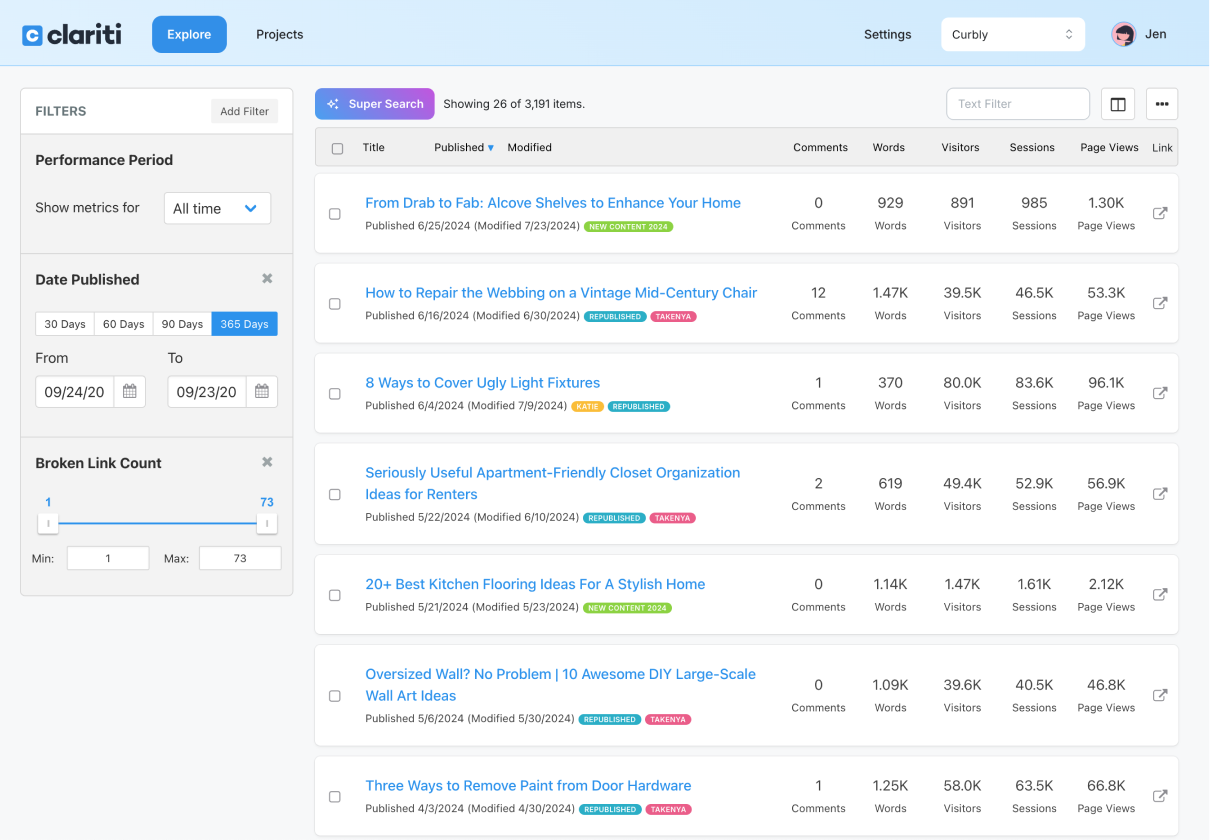
At its core, Clariti helps creators organize, prioritize, and optimize their content. It pulls in key data from Google Search Console, WordPress, and Google Analytics and ties it directly to your blog posts. It allows you to filter and create projects out of that data that it pulls in, which helps take the guesswork out of managing a content library.
Clariti helps creators make data-driven decisions. Why is that so important in an industry where people often lean on gut instincts or social media trends?
Gut instincts and trends are important to be aware of, but probably isn’t something you should build a process around. Traffic from TikTok or Instagram might spike today and vanish tomorrow. But quality content on a blog (that’s continually optimized) can compound over time. Data-driven decisions help creators build something stable, long-term, and resilient.
What’s one success story from a creator using Clariti that really stuck with you?
Here’s one that came in just this week from Heather at The Food Hussy:
“Clariti changed the game for me when it comes to analyzing my site. GA4 and console are confusing and not user friendly – plus they don’t have actionable things you can do on Day 1. Clariti is the best tool! Day 1 you can see what needs cleaned up, what to focus on and where your money is coming from. I love it!!!! Customer for Life!”
What’s the most underrated feature in Clariti that creators should be using more often?
Internal link tracking. It seems small, but building better connections between your posts is one of the easiest ways to improve SEO and user experience. Clariti surfaces opportunities where you’ve mentioned a recipe but never linked to it.
SEO & Content Strategy
Many food creators feel overwhelmed by SEO. How does Clariti help simplify that process?
Instead of trying to teach creators to be SEO pros, Clariti quietly bakes best practices into their workflow. It surfaces the “low-hanging fruit”: posts that rank on page two, posts missing schema, or posts with broken links. It’s not about dumping more SEO jargon on creators, it’s about showing them the next best thing they can do today.
How do you see structured content, schema, and metadata playing a role in the way Clariti evolves?
Schema is the language search engines “speak,” and creators need to be fluent if they want their content to stand out in a world of rich snippets, recipe cards, and AI-generated answers. Clariti’s role will be making sure creators know when their schema is missing, outdated, or incomplete, without them needing to be technical experts.
Clariti helps creators optimize old posts. Why is going back to “content you already have” such an opportunity?
It’s leverage. You’ve already done 80% of the work of writing, photographing, publishing. Updating old content gives you outsized returns compared to creating something brand new. It’s like remodeling a house you already own instead of building a new one from scratch.
Looking ahead, how do you see tools like Clariti supporting food bloggers as search platforms (Google, Pinterest, AI assistants) continue to shift?
Our hope is to build Clariti as a single source of truth for content. Clariti’s role is to give visibility across platforms and ensure their content is structured, optimized, and future-proofed, no matter where the traffic is coming from.
Business & Growth
Clariti started within the food blogging space but has potential for other niches. Do you see expansion beyond food creators in the future?
For sure! Food was the proving ground because that’s our world, but the problem isn’t unique to food. Travel bloggers, lifestyle creators, even small publishers all wrestle with the same issue: managing a massive library of content without drowning in spreadsheets. Long-term, Clariti is for anyone building a content-driven business.
What’s been the biggest challenge scaling Clariti from an internal tool into a SaaS platform?
The mindset shift. Using it internally, you can tolerate rough edges because we knew how it worked. Scaling it as SaaS meant investing in user experience, onboarding, customer support, billing…things that don’t feel glamorous but are absolutely essential to building a successful saas.
How do you balance building features creators say they want vs. features you know they’ll need long-term?
It’s a mix of listening and leading. We take creator feedback seriously, but we also try to read the “why” behind requests. Sometimes what someone asks for is a symptom, not the solution. Our job is to solve the root problem in a way that not only helps today but will still matter in five years.
Founder Insight
You and Lindsay have built multiple businesses together. How has working in partnership shaped the way you approach Clariti?
Lindsay isn’t directly involved in the day-to-day work of Clariti, as her primary focus is still on Pinch of Yum. But the experience of building businesses together has shaped how I approach Clariti in a big way. We’ve learned to recognize and respect different strengths: someone might bring deep creative insight and audience perspective, while another team member might lean more toward systems and business building. What makes Clariti possible is our internal team. They’re the real partners in the day-to-day, engineers, designers, the support tean who are building and shaping the product. Lindsay’s and my past experiences created the foundation and helped shape the initial product, but it’s the current team’s day-to-day efforts and collaboration that makes Clariti what it is today.
What does “doing this right” mean to you when building tech for creators?
It means respecting their time and energy. Creators don’t need another complicated dashboard or vanity metric. Doing it right means building something that’s reliable, actionable, and doesn’t waste their limited bandwidth.
What advice would you give to a food blogger who’s just realizing their content is an asset and not just a post?
Treat each piece of content like a rental property. It can generate value for years if you maintain it. The sooner you start thinking that way, the sooner you’ll see the compounding effect of optimizing what you already own.
“Updating old content gives you outsized returns compared to creating something brand new.”
Rapid Fire
- I believe any problem can be solved with… a clear process and consistent action.
- My guilty pleasure food is… Uncrustrables.
- When I need liquid courage, I reach for… an NA beer.
- A book, podcast, or app I can’t live without is… Clearspace (app).
- If I weren’t building this company, I’d probably be… doing something in real estate…or playing barbies with my daughters.
- One recipe I always go back to when life is busy is… Lindsay’s creamy chicken wild rice soup—it’s Minnesota comfort food.
- Dream collaborator (dead, alive, or fictional)… Mister Rogers
- Quote or mantra I come back to often is… a tiny bit better, everyday, forever.
Clariti was born from real creator problems and a simple belief: content is an asset. Bjork’s north star isn’t fads or vanity metrics—it’s building durable systems that help creators focus, iterate, and grow with less guesswork. That’s a roadmap any builder can get behind.
