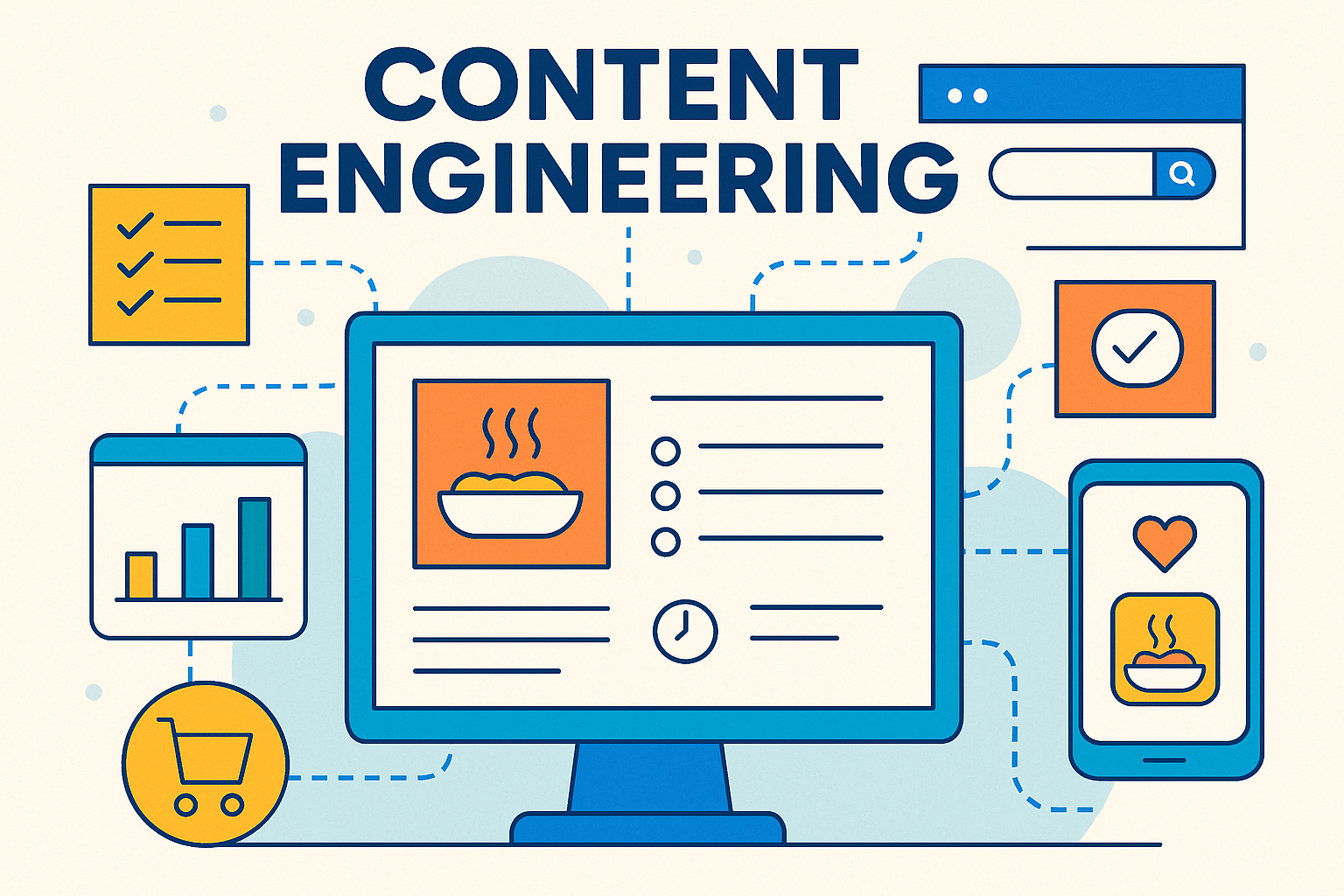
Content engineering is one of the least understood but most important parts of modern food content.
It’s how recipes stop being single-use blog posts and become structured, portable assets that fuel SEO,
generative search engines, shoppable experiences, cooking apps, and future food-tech systems.
What is content engineering in food (and why does it matter)?
Food creators publish some of the most complex content on the internet.
A single recipe includes ingredients, units, steps, times, yields, equipment, visuals, nutrition, metadata,
tags, culture, and monetization layers. But most recipe content online is still built as unstructured narrative
posts that search engines struggle to interpret.
And now the food ecosystem has shifted.
Recipes aren’t just competing on blogs anymore—they’re powering:
- Generative search engines
- Meal planners and smart grocery carts
- AI-powered cooking tools
- Mobile cooking apps
- Licensing deals across food-tech platforms
All of these systems require structured content—not just well-written posts.
Short Answer
Content engineering in food is the discipline of modeling, structuring, and managing recipe content
so it can be reused, cited, searched, integrated, and monetized across every platform—not just the blog.
Put simply: it’s how your recipe library becomes a real asset.
Why food creators need content engineering
Most food creators feel disorganized because their content wasn’t built to scale.
Your recipes live as individual posts, tags are inconsistent, metadata changes from recipe to recipe,
schema is incomplete, and updating older content feels like a guessing game.
Content engineering solves these problems by creating a structured recipe system that stays consistent
no matter how big your library becomes.
When structure is missing…
Your content becomes:
- Hard for search engines to interpret
- Unusable for generative engines
- Impossible to license easily
- Inconsistent across platforms
- Vulnerable to future algorithm shifts
Structure isn’t just about SEO—it’s about future-proofing your content.
This connects directly to the larger themes across Blueberri Bytes:
These aren’t isolated topics—they’re all part of content engineering.
The five pillars of content engineering
Content engineering in food is easier to understand when you break it down into five core components:
The Five Pillars
- Content modeling – Defining required fields for each recipe
- Metadata & taxonomy – Consistent tags, diets, cuisines, and methods
- Schema – Mapping your model into structured data for search
- Systems & workflows – Ensuring consistency as your library grows
- Governance – Assigning ownership for updates and quality
Most creators already do pieces of this work.
Content engineering simply organizes it into a system that gives your recipes long-term value.
How content engineering improves SEO and GEO
Traditional SEO focuses on headlines, keywords, internal links, and page experience.
These still matter, but food content has additional complexity that search engines must decode.
When recipes aren’t structured, SEO suffers
- Search engines can’t interpret ingredients correctly
- Steps get lumped into paragraphs and lose clarity
- Methods, cuisines, and diets become impossible to categorize
- Schema mismatches trigger errors in Search Console
GEO takes this even further: generative engines need structured clarity to answer user questions accurately.
GEO Pattern: Answer first
Generative engines pull from the first clear answer they can find.
Start your content with a direct, scannable explanation—then expand.
Content engineering gives SEO and GEO the clarity they need.
What content engineering looks like across the food ecosystem
For bloggers & independent creators
You’re not just writing recipes—you’re running a content system.
Content engineering helps you:
- Build a structured recipe database
- Use consistent metadata across your library
- Fix old content with a repeatable workflow
- Repurpose content into new channels (ebooks, courses, partnerships)
- Prepare for licensing or integrations
For food-tech companies
Content engineering is essential for food-tech product development.
Without structured recipes, core features break.
- Allergy filters can’t read ingredients
- Recommendation engines misclassify recipes
- Grocery systems can’t match ingredients to products
- Meal planners can’t create week-long menus
- Search tools can’t categorize cuisine or method
Companies building meal planners, AI cooking assistants, smart grocery carts,
and automation tools all rely on structured content to work.
For emerging AI and agentic systems
AI tools don’t “read” blogs—they read data.
The future of food content won’t depend on narrative posts.
It will depend on structured components that AI can assemble:
- Personalized cooking plans
- Ingredient substitutions
- Smart grocery shopping
- Hands-free cooking assistants
Content engineering is the foundation that allows these tools to work.
Core practices to adopt today
1. Build a consistent recipe model
The biggest mistake creators make is designing their recipe structure post-by-post.
Your recipe model should be defined once, then reused forever.
- Ingredients (structured)
- Steps (one per field)
- Times
- Yields
- Equipment
- Diets
- Cuisine
- Method
- Alt-text
- Schema alignment
2. Fix metadata inconsistencies
Unpredictable metadata confuses every system that touches your content.
Consistency is the secret weapon of high-performing food blogs.
Metadata Check
Ask yourself:
- Do I tag “30-minute” vs “quick” vs “weeknight” inconsistently?
- Do I mix “gluten free,” “gluten-free,” and “GF”?
- Do I switch between “stovetop” and “stove-top”?
Fixing these improves SEO, GEO, and user experience.
3. Separate structure from storytelling
Your recipe data should exist independently from your blog post design.
Structure is for machines. Story is for people.
They work together, but they should not be tied together.
4. Make schema part of your workflow
Schema should be generated from your recipe model—not hand-built.
This eliminates errors and keeps your structure clean.
5. Update content based on real data
Stop guessing what to update.
Tools like Clariti and Search Console tell you exactly where to start.
A simple roadmap to implement content engineering
Stage 1: Stabilize
- Audit your top 50–100 recipes
- Fix metadata inconsistencies
- Correct schema errors
- Build a basic recipe-tracking sheet
Stage 2: Structure
- Define your recipe model
- Update older content to match the model
- Create structured exports
- Build internal linking hubs
Stage 3: Scale
- Prepare licensing-ready formats (JSON, CSV, XML)
- Optimize cornerstone content for GEO
- Integrate your content into partner tools
- Document governance processes
Other questions about content engineering
Do I need to be technical?
No. Most of the work is editorial and organizational, not development.
Does this replace SEO?
No. It strengthens SEO and enables GEO.
Do I need schema?
Yes, if you care about search visibility.
Is this only for large platforms?
No. Solo bloggers benefit as much as enterprise teams.
Does every recipe need to be structured?
If you want your library to scale, yes.
Your recipe library is an asset. Content engineering unlocks its value.
Content engineering is how food creators build sustainable, future-ready content systems.
It turns every recipe into a structured, discoverable, monetizable asset—ready for any platform,
search engine, or tool that comes next.
SEO changes will continue. Algorithms will shift.
Platforms will evolve.
But structured content remains stable.
That’s why content engineering isn’t optional anymore.
It’s the foundation for the next decade of food content.

