Most organizations think they have a tooling problem. They think they need a better CMS, stronger governance, cleaner workflows, improved AI implementation, or better documentation standards.
Sometimes they do. But increasingly, the deeper issue is something far less visible: they do not have a shared language system.
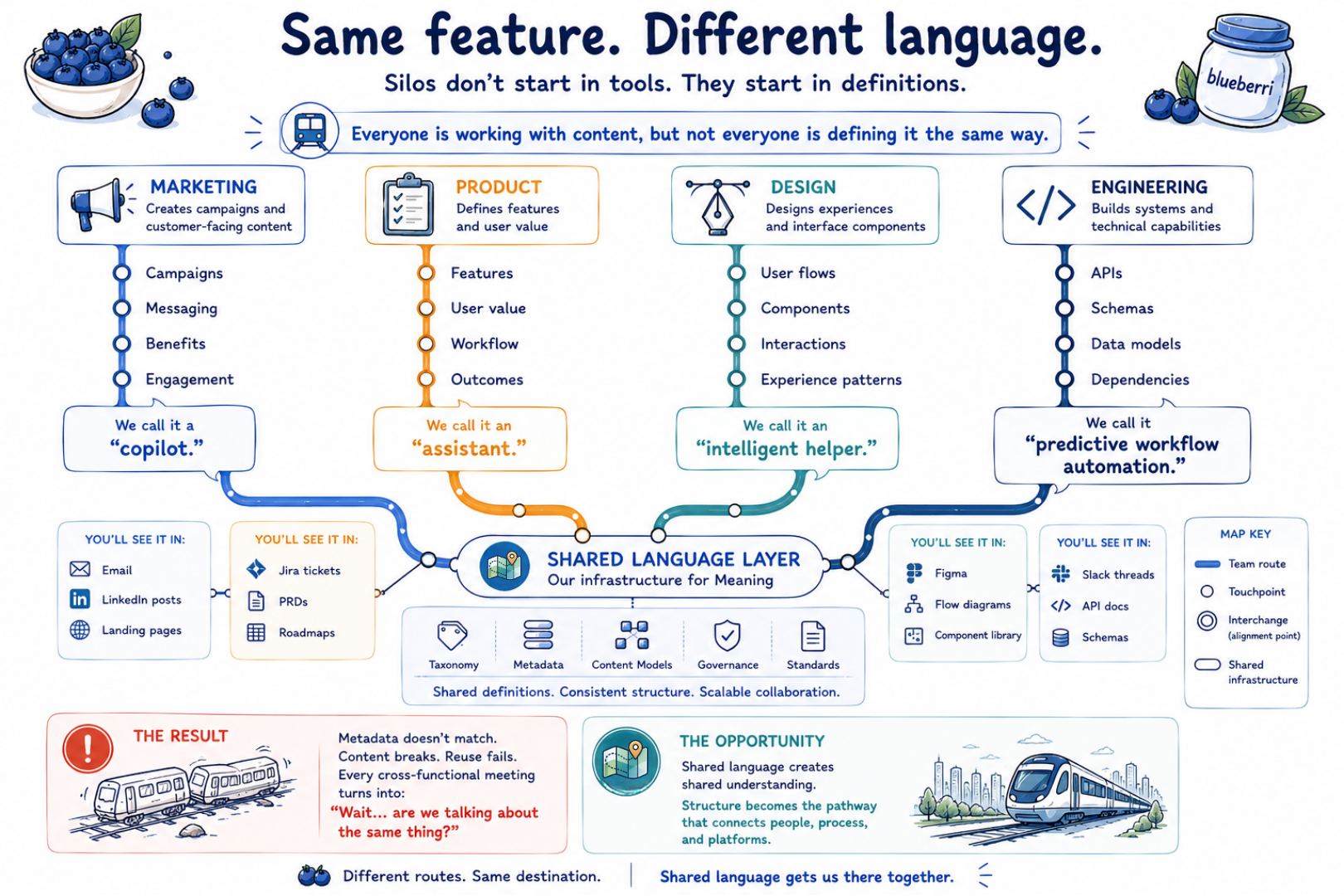
A product team launches a new feature and every department describes it differently. Marketing positions it one way. Product documentation explains it another way. Engineering labels it something completely different inside APIs and schemas. UX writers structure onboarding language differently than support articles. Leadership expects consistency across every touchpoint, but the organization never aligned around shared operational meaning in the first place.
At small scale, teams compensate. Slack messages fill the gaps, meetings become translation layers, and institutional knowledge becomes the connective tissue between systems.
Then the organization grows. Content expands across websites, apps, email, chatbots, support systems, AI experiences, onboarding flows, release notes, and internal knowledge platforms. Suddenly, the friction that once felt manageable starts appearing everywhere.
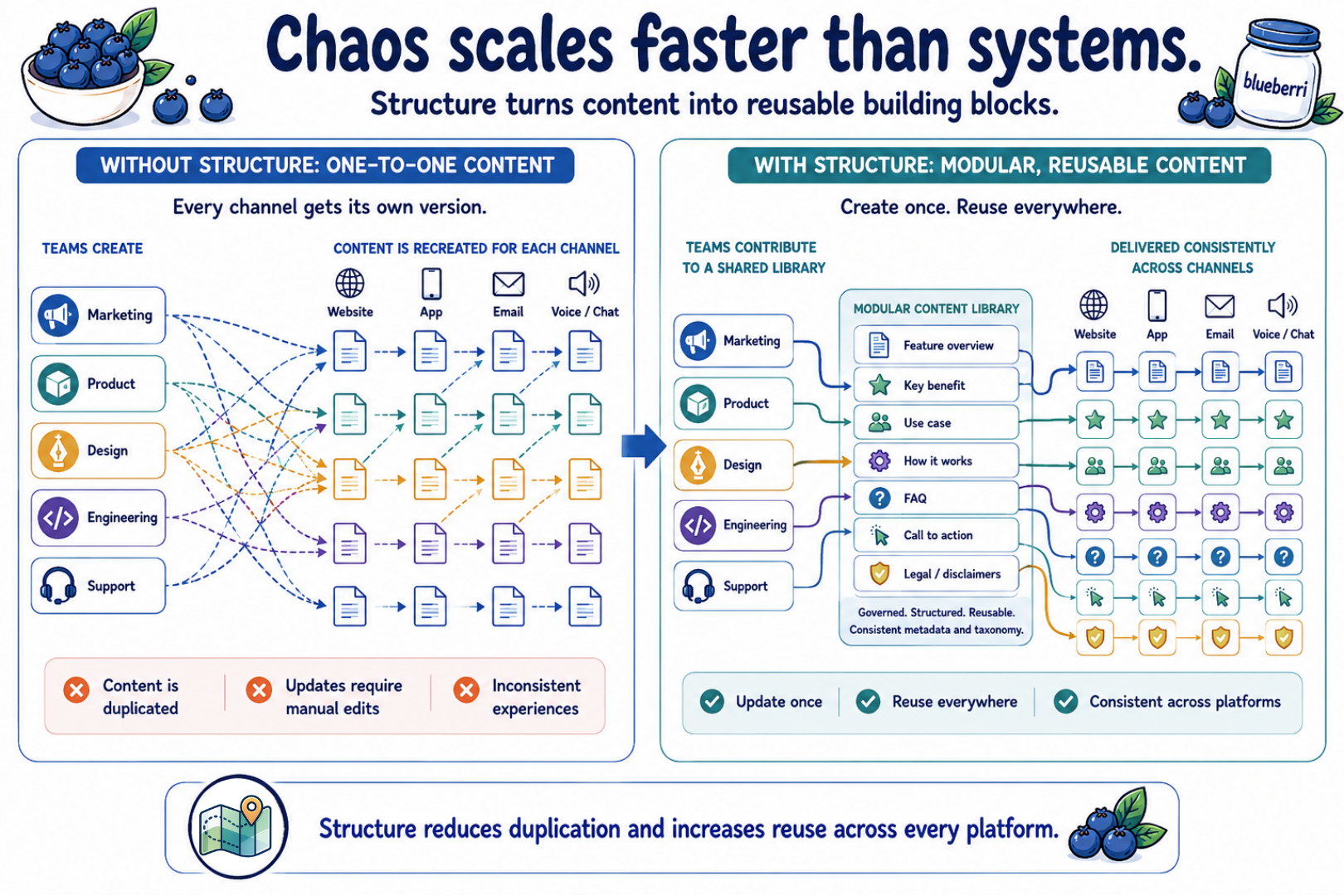
Content duplication increases, metadata becomes inconsistent, reusable systems begin breaking apart, and cross-functional alignment slows down. Every new platform transition exposes another layer of structural inconsistency hiding underneath the workflow.
This is the problem MAP was created to address.
MAP stands for Meaning, Alignment, and Platforms. At its core, MAP is a framework for helping organizations create shared operational understanding across teams, systems, and platforms.
Because scalable collaboration does not begin with publishing. It begins with shared meaning.
Most silos begin as language breakdowns
Organizations often describe silos as communication failures between departments. But communication problems rarely begin with communication itself. They begin when teams stop defining things the same way.
Marketing uses one set of terminology. Product uses another. Design teams think in components and interactions while engineering teams think in schemas, APIs, and data models. Support teams organize information around customer problems while leadership focuses on business goals and KPIs.
Everyone is working with content, but not everyone is defining content the same way. Over time, those inconsistencies become operational friction that spreads across workflows, systems, and communication pathways.
Different teams can work on the same content while using completely different definitions. MAP helps make those differences visible so teams can align around shared meaning.
A feature gets renamed midway through launch, metadata fields stop aligning across systems, and reusable content becomes harder to maintain. Localization teams inherit inconsistent terminology while AI systems surface conflicting information because the underlying structure lacks consistency.
What starts as a vocabulary issue eventually turns into a systems issue. This is one reason structured content conversations are evolving beyond publishing efficiency.
The future of content operations is not just about reuse. Increasingly, it is about alignment.
Structure is not just technical infrastructure
Structured content is often framed as a technical implementation problem. Teams talk about content models, metadata, taxonomy, schemas, governance systems, component libraries, and composable architecture. Those conversations matter because structure absolutely impacts how content moves across platforms.
But the deeper organizational impact is often overlooked. Structure is not just technical infrastructure. It is operational infrastructure because it shapes how meaning travels between teams.
A content model is not simply a technical artifact stored inside a CMS. It becomes an operational agreement that influences how product, marketing, design, support, and engineering teams interpret and reuse information. Metadata is not just descriptive labeling. It acts as routing logic that determines how content surfaces across platforms, AI systems, search experiences, personalization engines, and workflows.
Taxonomy is not merely categorization. It becomes a shared organizational language system that influences how teams organize, retrieve, and communicate information at scale.
This is one reason structured content conversations are becoming increasingly tied to organizational alignment and operational scalability. As organizations adopt composable systems and omnichannel publishing environments, teams quickly discover that knowing about headless CMS architecture is only the beginning. Without consistent operational language, even the most flexible platforms eventually inherit fragmented workflows and disconnected systems.
In many organizations, teams unknowingly create parallel definitions for the same concepts across departments, which slowly introduces operational friction into the ecosystem.
This becomes especially visible during platform migrations, AI implementation projects, localization efforts, and omnichannel expansion. Industries managing highly structured ecosystems—especially food media and recipe publishing—have already experienced how reusable content systems fundamentally change publishing operations, discoverability, and cross-platform delivery. Many of the same structural challenges appearing in enterprise environments today have existed for years inside recipe ecosystems built around metadata, taxonomy, and reusable content relationships, which is explored throughout this deep guide to structured content systems for food creators.
A reusable content model only works when teams share consistent understanding around what the content actually represents. Without that shared meaning, structure begins fragmenting and workflows slowly become harder to maintain.
This is why structured content is increasingly moving beyond publishing efficiency alone. Structured systems are becoming essential for operational clarity, reusable workflows, and scalable collaboration across modern content ecosystems. The shift from traditional publishing workflows toward reusable, structured ecosystems changes not only how content is delivered, but also how organizations communicate internally.
When content is created one channel at a time, duplication grows quickly. Structured systems make reuse easier because teams can create once, adapt intentionally, and maintain consistency across platforms.
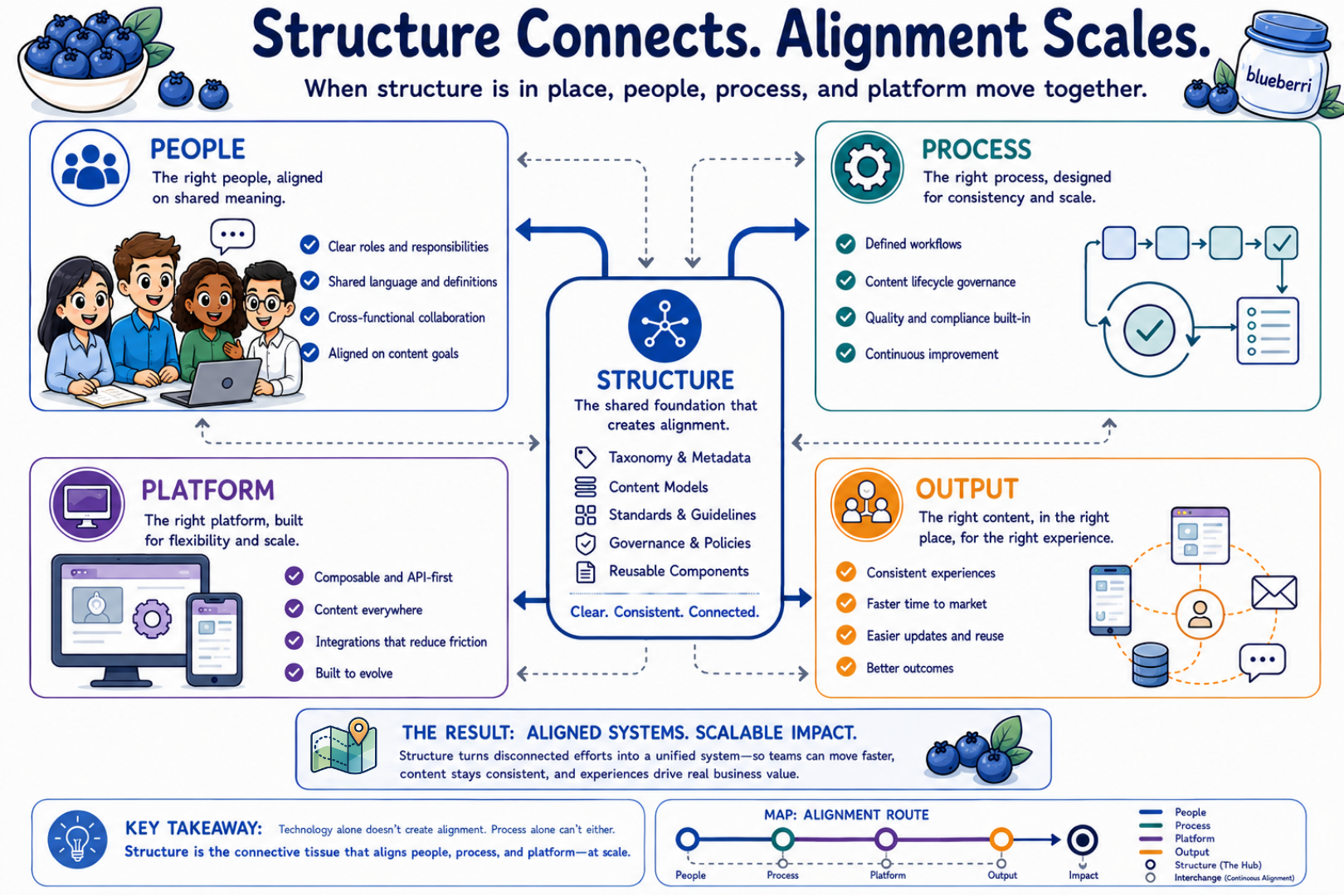
When organizations treat structure purely as a publishing concern, they miss the much larger operational opportunity. Structure is what allows people, systems, workflows, and platforms to understand each other consistently.
Without shared structure, organizations rely on individuals to manually bridge gaps between disconnected systems through meetings, Slack threads, spreadsheets, tribal knowledge, and institutional memory. That approach may work temporarily, but it does not scale.
Over time, scalable organizations realize that structure is not simply supporting content production. It is supporting alignment itself.
MAP positions structure as the connective layer between people, process, and platforms—not as a technical detail that lives only inside the CMS.
The hidden cost of inconsistent meaning
Many operational inefficiencies are actually semantic inconsistencies hiding inside workflows. A team might think they have a workflow problem, a governance problem, a documentation problem, a CMS problem, or an AI implementation problem. Sometimes the deeper issue is simpler: the organization never established shared definitions.
For example, what exactly defines a “feature”? Is a “component” the same thing across teams? What differentiates a “workflow” from a “process” internally? Does “campaign” mean the same thing in marketing, product, and analytics? What counts as reusable content?
When organizations cannot answer these questions consistently, systems begin fragmenting. Teams create duplicate structures, content becomes harder to reuse, data loses reliability, and cross-functional collaboration slows down.
Eventually, organizations spend more time translating information than creating value. This becomes especially visible during platform migrations, omnichannel expansion, AI implementation, localization initiatives, enterprise scaling, and content operations transformation. Every transition exposes the gaps.
AI did not create the mess
AI is accelerating conversations around structured content because it exposes inconsistencies organizations were already living with. Large language models depend heavily on consistency, structure, context, metadata, and reliable relationships between information.
Organizations with fragmented content ecosystems often discover that AI surfaces conflicting answers, inconsistent terminology, duplicated knowledge, and unreliable outputs. The problem is not always the AI. The problem is often the underlying content ecosystem.
AI did not create the mess. It exposed inconsistencies organizations were already struggling to manage behind the scenes.
This is why conversations around AI readiness increasingly overlap with conversations around content operations, taxonomy, governance, and structured content systems. Organizations are realizing that scalable AI experiences depend on scalable meaning. And scalable meaning requires structure.
Why MAP matters now
The content landscape has changed dramatically. Content is no longer created for a single destination. Organizations now support websites, mobile apps, support centers, AI assistants, chatbots, knowledge systems, product tours, email journeys, voice experiences, personalization engines, and internal enablement systems.
Content moves everywhere, but many organizations are still operating with workflows designed for static publishing environments. That disconnect creates pressure across every department as systems expand faster than operational alignment.
Teams feel overwhelmed, work becomes reactive, and alignment becomes increasingly difficult as more systems, channels, and stakeholders enter the ecosystem. The more places content needs to go, the more structure matters. And the more teams involved in content operations, the more shared language matters.
This is where MAP becomes operationally valuable. MAP helps organizations think beyond isolated systems and toward connected ecosystems. It reframes structure as organizational infrastructure instead of technical overhead.
Meaning comes first
The first layer of MAP is meaning. Before organizations can scale systems, they must establish shared understanding.
This sounds obvious, but many organizations skip this step entirely. Teams begin implementing platforms, workflows, and governance structures without first aligning around the language itself.
Meaning answers questions like: What is this content object? How is it defined? Does every team define it the same way? What metadata relationships matter? What language should remain consistent across systems? Which terms create confusion internally?
Without shared meaning, organizations build inconsistent systems on top of inconsistent assumptions. This is one reason content migrations become difficult. The organization is not just migrating content. It is migrating inconsistent definitions.
MAP encourages organizations to slow down and define shared operational language before scaling complexity. Because once systems expand, inconsistency scales with them.
Alignment is operational infrastructure
Alignment is often treated as a soft skill. Something cultural. Something interpersonal. But operational alignment is structural.
Organizations become aligned when systems reinforce shared understanding consistently. That alignment appears through governance, taxonomy, naming conventions, workflow standards, metadata strategy, documentation patterns, reusable models, and platform consistency.
Alignment is what allows organizations to move faster without increasing chaos. It reduces duplicate work, improves trust between teams, and creates operational clarity across workflows and systems.
Most importantly, it helps organizations scale without relying entirely on institutional knowledge. When alignment is weak, organizations become dependent on individuals to manually connect disconnected systems. That creates burnout, and it also creates fragility.
If alignment only exists inside people’s heads, the system itself is unstable. MAP reframes alignment as infrastructure rather than interpersonal coordination.
Platforms should reinforce meaning, not fragment it
Platforms are often introduced as solutions. A new CMS. A new DAM. A new governance platform. A new AI layer. A new workflow tool. But platforms cannot solve semantic inconsistency on their own.
If organizations bring inconsistent structures into new systems, they often reproduce the same operational problems at larger scale. Technology amplifies structure. Good structure scales clarity, while weak structure scales confusion across every connected platform.
This is why platform conversations should never happen separately from conversations around meaning and alignment. The platform layer should reinforce shared understanding, not create additional fragmentation.
Fragmented platform behavior
Aligned platform behavior
Best next step
Teams create separate naming conventions inside separate tools.
Shared terminology is documented and reinforced across systems.
Create a shared vocabulary layer before adding more workflows.
Metadata exists, but each department uses fields differently.
Metadata has defined ownership, usage rules, and governance.
Audit high-value metadata fields for inconsistency.
Reusable content breaks when it moves across channels.
Reusable models are designed around shared meaning and platform needs.
Map one content object from source to every destination.
Organizations that scale successfully across channels usually share consistent naming conventions, reusable content structures, strong metadata relationships, governance clarity, cross-functional collaboration, and aligned operational language. Their systems reinforce shared meaning instead of constantly translating between disconnected definitions.
MAP and content operations
MAP is deeply connected to content operations because content operations sits at the intersection of systems, workflows, governance, and collaboration. Content operations is not simply about publishing efficiency. It is about reducing operational friction across the entire content ecosystem.
That includes workflows, governance, team alignment, content lifecycle management, reusable systems, structured publishing, platform consistency, and communication pathways.
This is why content operations teams increasingly act as connective infrastructure across organizations. They often become the people translating between departments.
MAP provides a framework for making that translation layer more sustainable. Instead of relying solely on people to bridge gaps, organizations build systems that support alignment directly.
MAP and UX writing
UX writers and content designers are uniquely positioned inside this conversation. They sit close to user experience, product language, design systems, platform interactions, content consistency, and interface clarity.
They often see language fragmentation earlier than other teams because inconsistent terminology directly impacts user trust. A product cannot feel cohesive externally if teams are not aligned internally.
This is one reason UX writing and structured content conversations are increasingly overlapping. The future of UX writing is not only interface copy. It is systems thinking.
Content designers increasingly influence naming conventions, reusable patterns, content governance, component systems, AI interactions, and operational consistency. MAP helps frame this work as organizational alignment rather than isolated content production.
Shared language creates scalable collaboration
One of the core philosophies behind MAP is simple: shared language creates scalable collaboration.
Organizations cannot scale effectively when every department defines content differently. Eventually, workflows slow down, trust erodes, duplication increases, systems fragment, AI outputs become unreliable, governance becomes reactive, and content reuse becomes difficult.
Structure reduces ambiguity. And reduced ambiguity allows organizations to move faster with greater consistency.
This is why modern content strategy increasingly overlaps with systems thinking, information architecture, governance, organizational design, operational alignment, and platform strategy. The future of content work is deeply cross-functional. MAP helps organizations navigate that complexity.
Why this matters beyond content teams
One of the biggest misconceptions about structured content is that it only matters to content teams. In reality, structure impacts product development, customer experience, support systems, AI readiness, analytics, personalization, governance, localization, and operational scalability.
Shared language affects every layer of the organization. When structure improves, organizations often experience clearer workflows, faster collaboration, stronger governance, better reuse, more consistent customer experiences, improved AI outputs, and reduced operational friction.
The impact extends far beyond publishing. This is why MAP positions structured content as organizational infrastructure rather than niche technical implementation.
The future of content work is connective
Content work is evolving. Roles are becoming more hybrid, teams are becoming more interconnected, and platforms are becoming increasingly composable. At the same time, AI systems are increasing pressure on operational consistency, and organizations are realizing that disconnected workflows cannot scale indefinitely.
The future belongs to organizations that can create shared understanding, align systems consistently, structure content intentionally, reduce operational ambiguity, and build reusable ecosystems.
This is not just a technology conversation. It is an organizational one. MAP exists because modern organizations need better ways to connect meaning across people, process, and platforms.
Not simply publish faster. But operate more clearly.
Structure is becoming organizational infrastructure
For years, structured content was positioned primarily as a publishing strategy. Today, it is becoming something much larger: operational infrastructure for modern organizations. As content ecosystems become more interconnected, structure is increasingly shaping how teams collaborate, how systems communicate, and how organizations scale consistency across platforms.
The organizations that scale successfully in the next decade will not necessarily be the ones producing the most content. They will be the ones creating the clearest systems. Content chaos scales quickly, but aligned systems scale sustainably—and that alignment begins with shared meaning.
MAP™ framework & operational alignment
Content systems break when teams stop sharing meaning.
MAP™ explores how shared language, structured content, and operational alignment help modern organizations reduce friction across teams, platforms, workflows, and AI-driven content ecosystems.
Systems thinking for content strategists, UX writers, and content operations teams
Practical perspectives on structure, governance, and organizational alignment
Modern approaches to scalable content across platforms, products, and AI systems
Get thoughtful insights on structured content, operational systems, content design, and the future of cross-functional collaboration delivered to your inbox.