
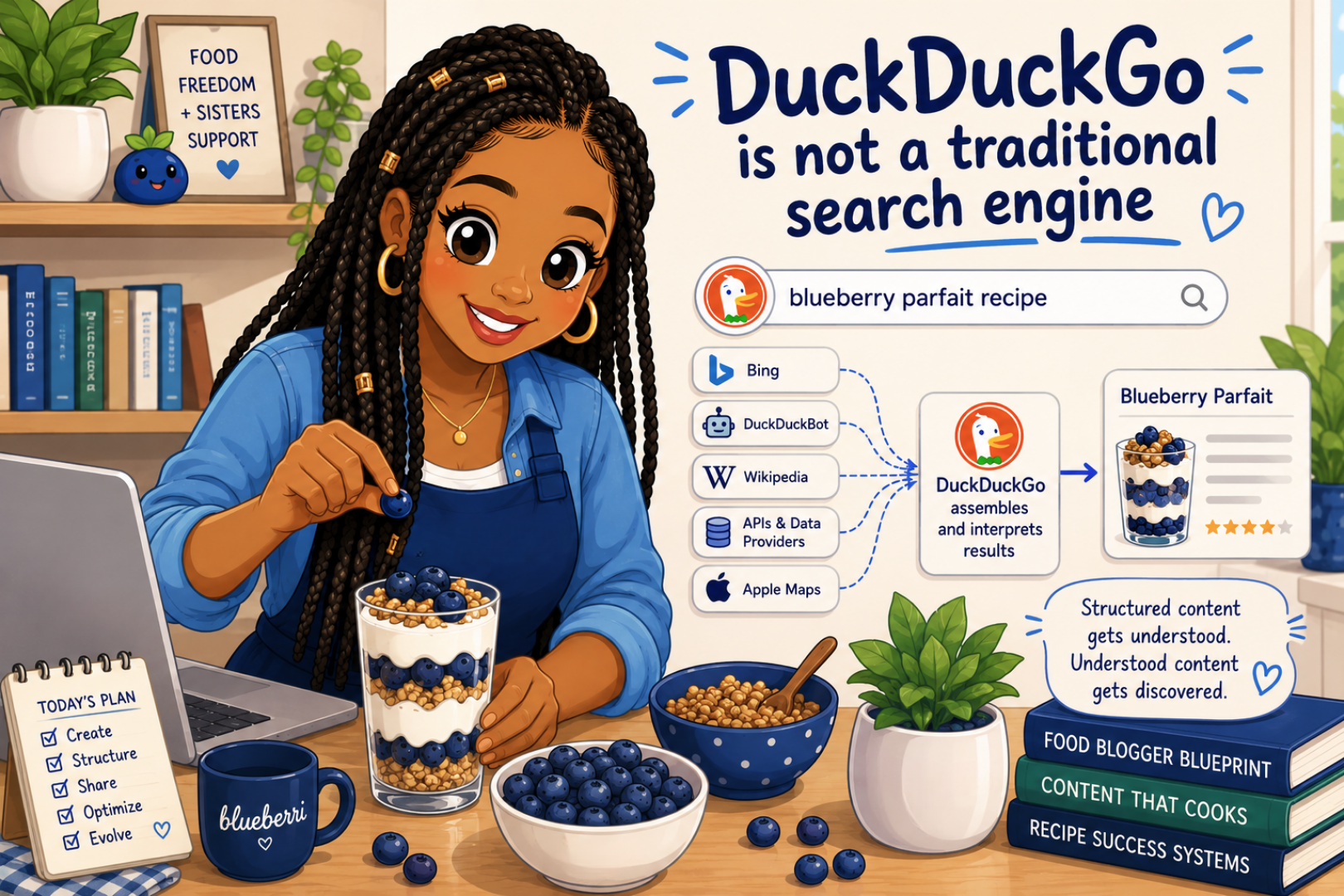
Most people assume all search engines operate in roughly the same way. A crawler visits webpages, an index stores information, and an algorithm decides what ranks first. That mental model largely comes from Google because Google has shaped how most people understand search itself.
TL;DR
DuckDuckGo is not a fully independent search engine like Google. Instead, it combines results from Bing, DuckDuckBot, APIs, and structured datasets to assemble search experiences. This article explores what that reveals about modern discoverability — and why structured content is becoming foundational infrastructure for AI retrieval, search visibility, and multi-platform publishing.
DuckDuckGo works differently.
While it does operate some of its own search infrastructure, DuckDuckGo is better understood as a hybrid retrieval system. Instead of relying entirely on a single proprietary index, it combines information from multiple sources and assembles those results into one search experience. According to DuckDuckGo’s own documentation about its search sources, those sources include Bing, DuckDuckBot, Wikipedia, Apple Maps, structured APIs, and external data providers.
That architectural difference matters because it changes the nature of discoverability.
Traditional search engines primarily focus on evaluating and ranking webpages within their own ecosystem. DuckDuckGo increasingly functions as an orchestration layer. Rather than asking only “What page should rank highest?” it also asks “What combination of sources produces the most useful answer?”
That shift may sound subtle, but it reveals something much larger happening across modern search systems.
For years, creators were trained to think about search visibility primarily through rankings. If a page appeared near the top of Google results, it was considered successful. If it failed to rank, it was considered invisible. That mindset shaped an entire generation of publishing strategies focused almost entirely on optimizing webpages for one dominant search engine.
But modern search behavior is becoming increasingly fragmented.
People no longer discover information exclusively through traditional search result pages. They discover recipes through voice assistants, AI summaries, social platforms, recommendation systems, embedded search interfaces, smart devices, and platform integrations. In many cases, users never even visit a traditional search engine homepage at all.
This changes the role search engines themselves play inside the broader internet ecosystem.
Search engines are increasingly evolving from isolated destinations into retrieval and interpretation systems that help move information between environments. DuckDuckGo exposes this transition especially well because it openly combines information from multiple external systems instead of pretending to operate as a completely closed ecosystem.
That openness reveals something many creators still underestimate: modern discoverability depends heavily on interoperability.
Content is no longer competing only as webpages. Increasingly, it competes as structured information capable of being extracted, interpreted, summarized, and redistributed across many systems simultaneously.
This creates a very different environment from the early days of SEO.
Older search optimization strategies often focused heavily on keyword repetition, backlinks, metadata tweaks, and technical ranking adjustments designed primarily for a single algorithmic environment. Those tactics still matter to some degree, but they are no longer sufficient on their own because discoverability itself has changed.
Today, systems increasingly need to understand meaning.
Machines need to understand what content represents, how entities relate together, what information belongs to which category, and how content can move across interfaces without losing context. That process becomes much easier when content is structured intentionally.
This is one of the clearest reasons structured content matters now far beyond traditional SEO.
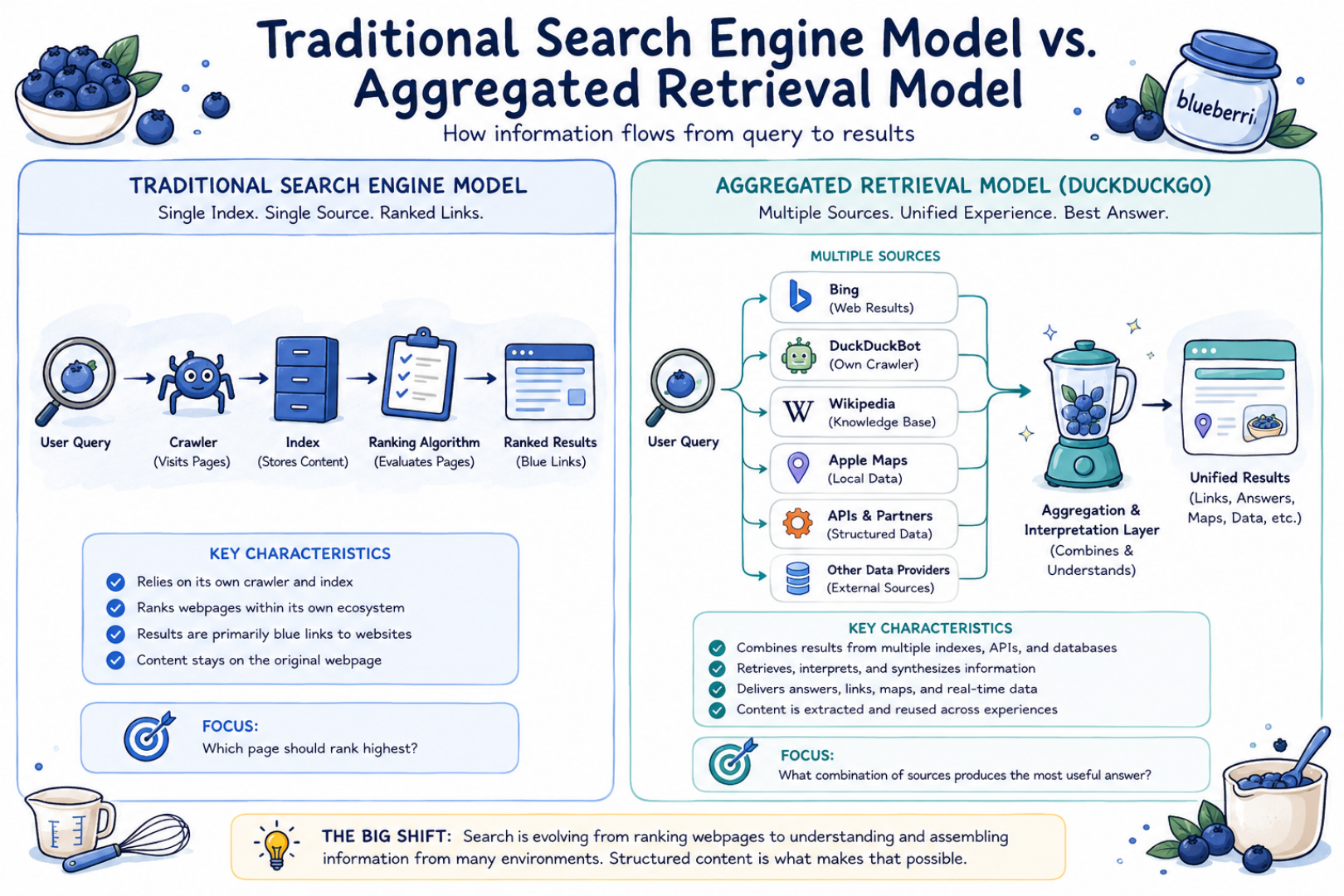
DuckDuckGo exposes this transition unusually well because its architecture depends heavily on structured and reusable information. A search engine that aggregates from multiple providers needs content to be consistent enough to interpret across systems. Pages that are vague, inconsistently formatted, or structurally weak become harder to reuse in these environments.
This directly connects to the COSE™ framework principle of Create with Structure.
Within the COSE framework, structure is not treated as a technical enhancement added later for optimization purposes. It is considered foundational infrastructure that allows content to move across systems predictably.
DuckDuckGo demonstrates this problem in real time.
When creators think only in terms of “ranking on Google,” they often overlook the broader ecosystem modern content now flows through. A recipe today may appear in traditional search results, voice assistants, shopping integrations, AI summaries, smart kitchen devices, and recommendation engines simultaneously.
Those systems depend on structured information because machines cannot reliably interpret ambiguity at scale.
That is why recipe content has become one of the most system-dependent forms of publishing online.
A recipe is no longer simply an article with ingredients and instructions. It is increasingly treated as a reusable content object containing entities, metadata, relationships, timing information, nutritional fields, and semantic structure that can be interpreted across environments.
The future of discoverability is becoming less about isolated webpages and more about interoperable content systems that machines can reliably understand.
Where DuckDuckGo results actually come from
Understanding DuckDuckGo requires understanding that it does not rely on a single information source. Instead, it assembles results from multiple layers that work together to produce the final search experience users see.
The largest of these layers is Bing.
DuckDuckGo publicly acknowledges that Microsoft Bing powers a significant portion of its web search results. This partnership forms an important part of DuckDuckGo’s infrastructure and heavily influences how content surfaces across the platform. DuckDuckGo explains this relationship further in its article on where DuckDuckGo search results come from.
That relationship matters because it means DuckDuckGo visibility is often indirectly shaped by Bing’s interpretation of content. In practical terms, creators are frequently optimizing for Bing systems even when they believe they are targeting DuckDuckGo.
This is one reason Google-only optimization strategies are becoming increasingly limiting.
Modern discoverability depends on interoperability between systems, not simply dominance within a single platform.
Content now moves through ecosystems of shared indexes, APIs, retrieval layers, and structured datasets. DuckDuckGo simply makes those dependencies more visible because its architecture openly relies on them.
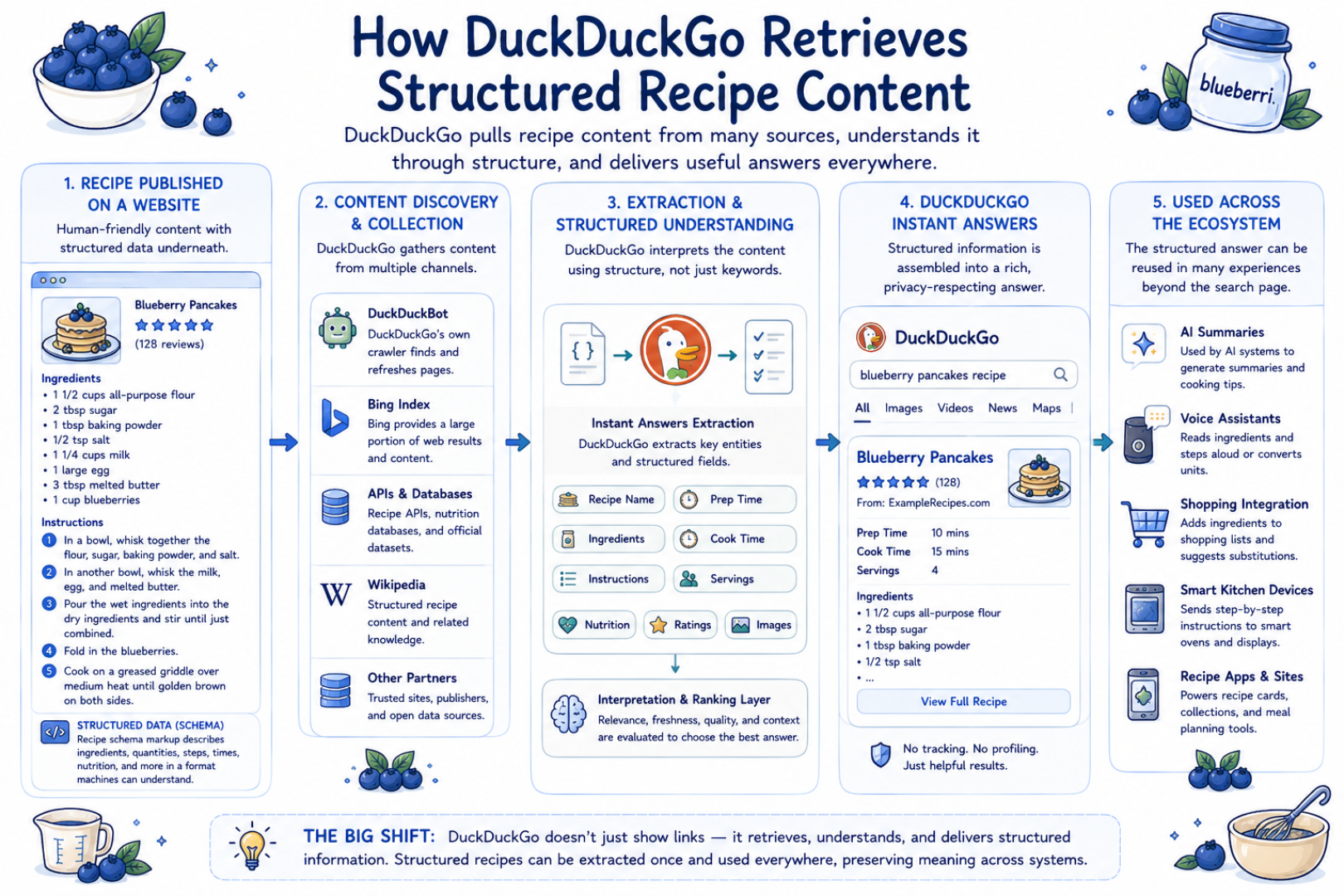
This aligns closely with the COSE framework principle of Share with Intention.
Content designed for one isolated destination struggles as ecosystems become more interconnected. Structured content, however, can travel between systems far more effectively because its meaning remains understandable outside the original webpage context.
DuckDuckGo also operates its own crawler, DuckDuckBot. According to DuckDuckGo’s documentation about DuckDuckBot, the crawler helps supplement indexing, improve freshness, and diversify result coverage.
Still, DuckDuckGo does not currently function as a fully independent search index at the scale of Google or even Bing.
Rather than functioning as a closed ecosystem, DuckDuckGo behaves more like an information assembly layer. It combines structured information from multiple systems into a unified interface optimized around privacy and usability.
Instant Answers reveal the future of search
DuckDuckGo’s Instant Answers system provides one of the clearest examples of structured retrieval in action.
Instead of simply displaying a list of blue links, Instant Answers attempt to directly extract and present useful information inside the search experience itself. DuckDuckGo explains this feature in its overview of Instant Answers and structured search responses.
These answers pull from sources including Wikipedia, Stack Overflow, official datasets, APIs, and structured databases.
This retrieval-focused model reflects a larger transformation occurring across search ecosystems.
Modern systems increasingly prioritize extracting information, summarizing information, and recombining information over simply directing users toward webpages.
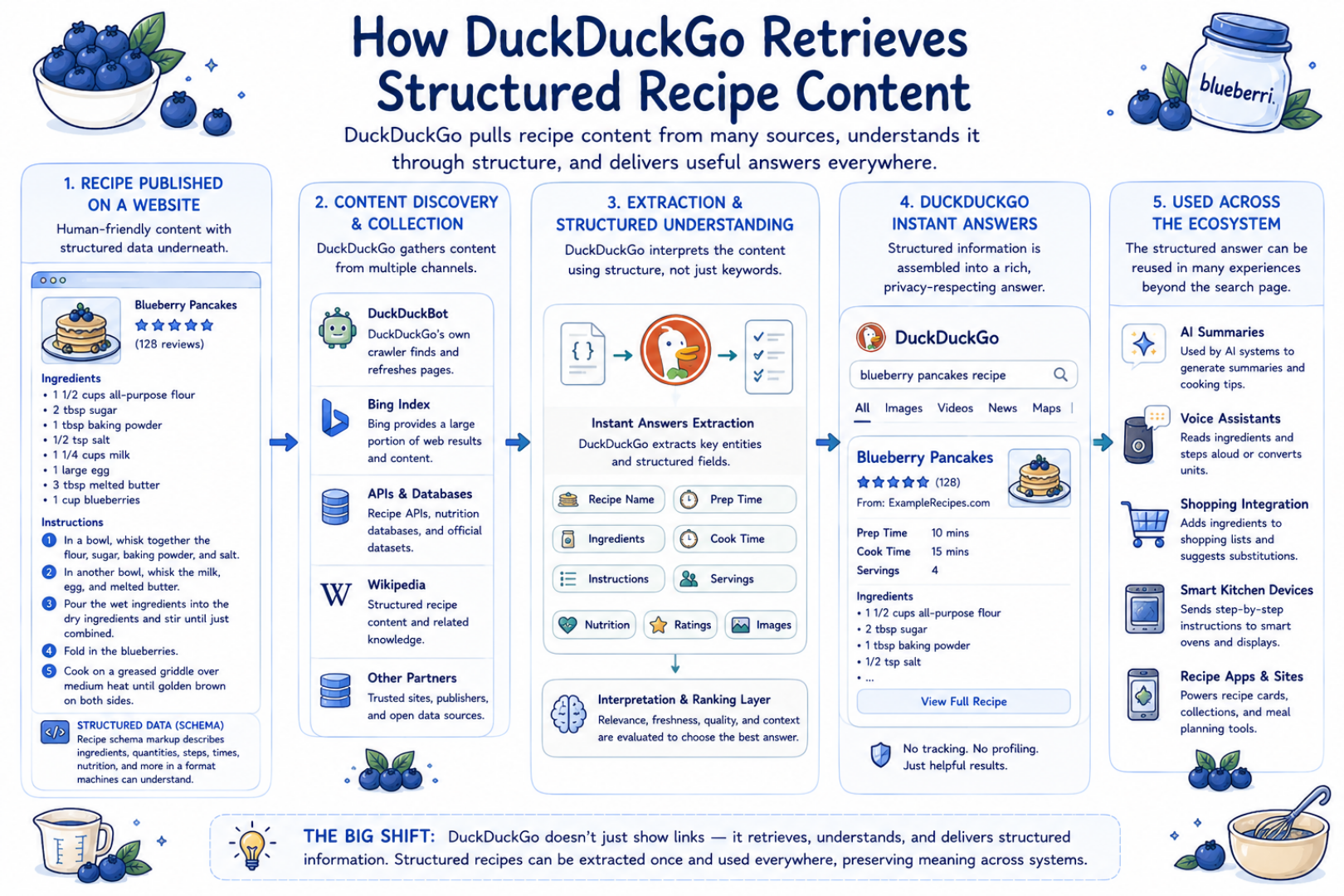
Recipes are especially important here because they are naturally structured information systems. Ingredients, quantities, timing, and instructions already follow patterns machines can understand when implemented consistently.
This is one reason recipe schema has become foundational infrastructure for modern food publishing.
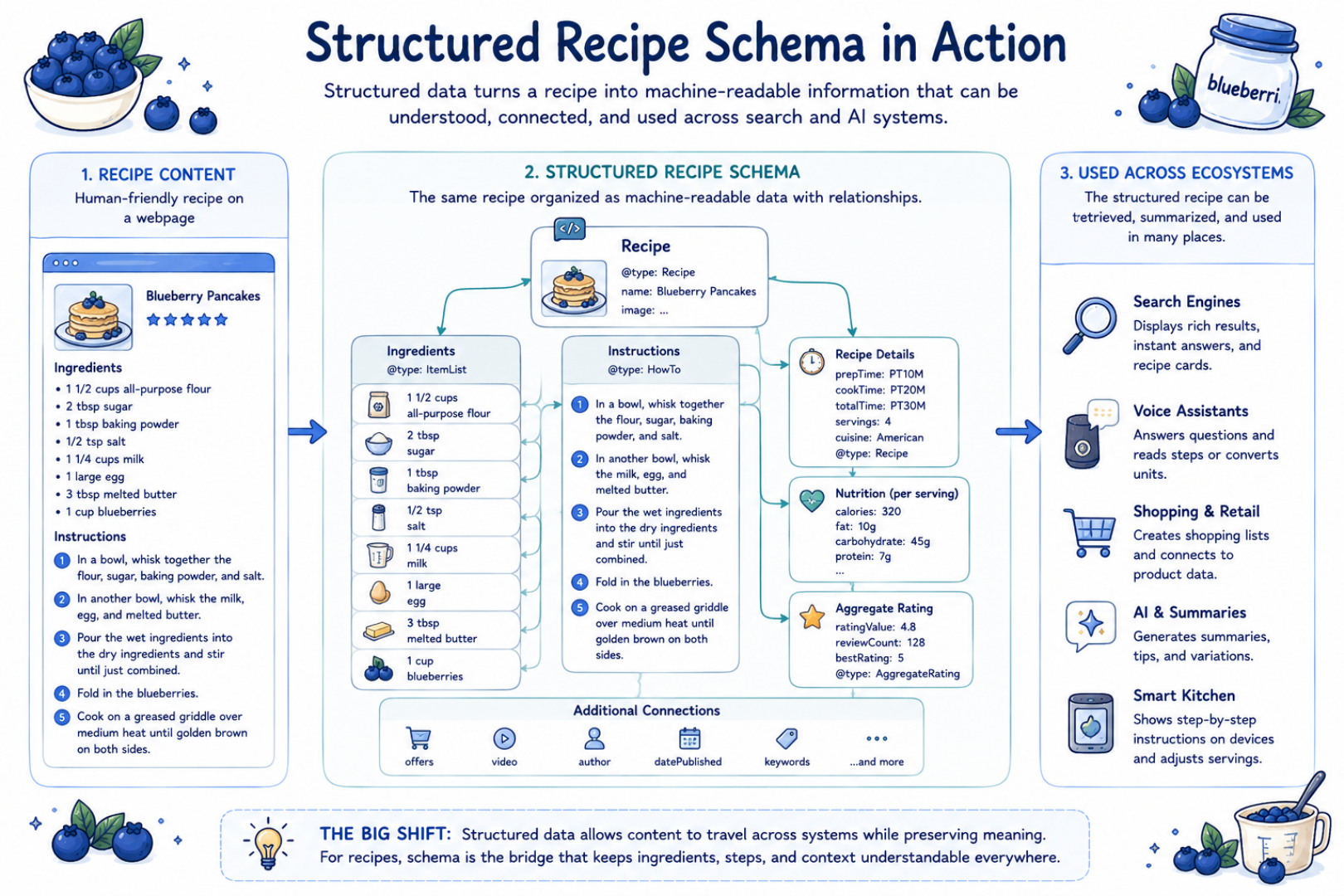
Schema allows recipes to function across search engines, recipe cards, smart assistants, shopping integrations, AI summaries, and recommendation systems.
Without that structure, systems are forced to guess.
And machines are not particularly good at guessing context.
That inconsistency creates friction. The more distributed search becomes, the more costly that friction becomes for discoverability.
The future of discoverability is structured
For creators, publishers, and content teams, this shift has significant implications.
It means discoverability can no longer be treated purely as a marketing function layered onto content after publication. Increasingly, discoverability is becoming an operational systems problem tied directly to how content is structured from the beginning.
The more places content needs to go, the more structure matters.
This is particularly important for food creators because recipe publishing sits at the intersection of so many retrieval environments simultaneously.
Without structure, that movement becomes fragile.
With structure, recipes become far more adaptable and reusable over time.
DuckDuckGo’s architecture simply makes that reality easier to see.
The platform exposes how dependent modern discoverability has become on systems capable of retrieving, assembling, interpreting, and redistributing information across multiple layers at once.
That future is already here.
And increasingly, the creators who succeed will not necessarily be the ones producing the most content. They will be the ones building the clearest systems underneath their content.