

You’ve likely heard the phrase “content is king,” but in 2025, content without context is invisible. That context is metadata—the recipe data that helps platforms, tools, and search engines understand what your content actually is, who it’s for, and where it fits. This post breaks down what metadata is, why it matters, and how food creators and food tech platforms can strengthen it without starting from scratch.
Why metadata matters more than ever for food creators and platforms
Metadata is the information that tells people and systems what your recipe actually is. Not what it looks like. Not how long it took to develop. But how it should be understood, grouped, found, and used again.
When you start thinking of a recipe as metadata-rich, something shifts. A recipe stops being “a post” and starts being:
- a type of meal
- for a specific moment
- with a clear purpose
- that belongs with other things
Blueberri editorial
Metadata is how your recipe becomes usable beyond your blog
A recipe can be beautifully written and still be difficult for platforms to interpret. Metadata is the structure layer that makes your recipe legible to search engines, recipe apps, shopping integrations, and step-by-step cooking experiences.
What is metadata?
At its core, metadata is data about data. It’s the hidden structure that describes your content. While your recipe might show up as a webpage, what platforms see is a set of fields, tags, and relationships.
Examples of recipe metadata:
- Title and author
- Prep time, cook time, total time
- Yield / servings
- Ingredients (ideally formatted consistently)
- Instruction steps (structured into individual steps)
- Cuisine and course (breakfast, dinner, snack)
- Dietary attributes (vegan, gluten-free, dairy-free)
- Difficulty
- Tags (one-pot, weeknight, meal prep)
- Description / summary
- Image alt text
- Open Graph fields (social preview data)
- Canonical URL (the “official” version of the page)
- Schema markup (structured recipe data)
Metadata tells platforms what your recipe is—not just what it says.
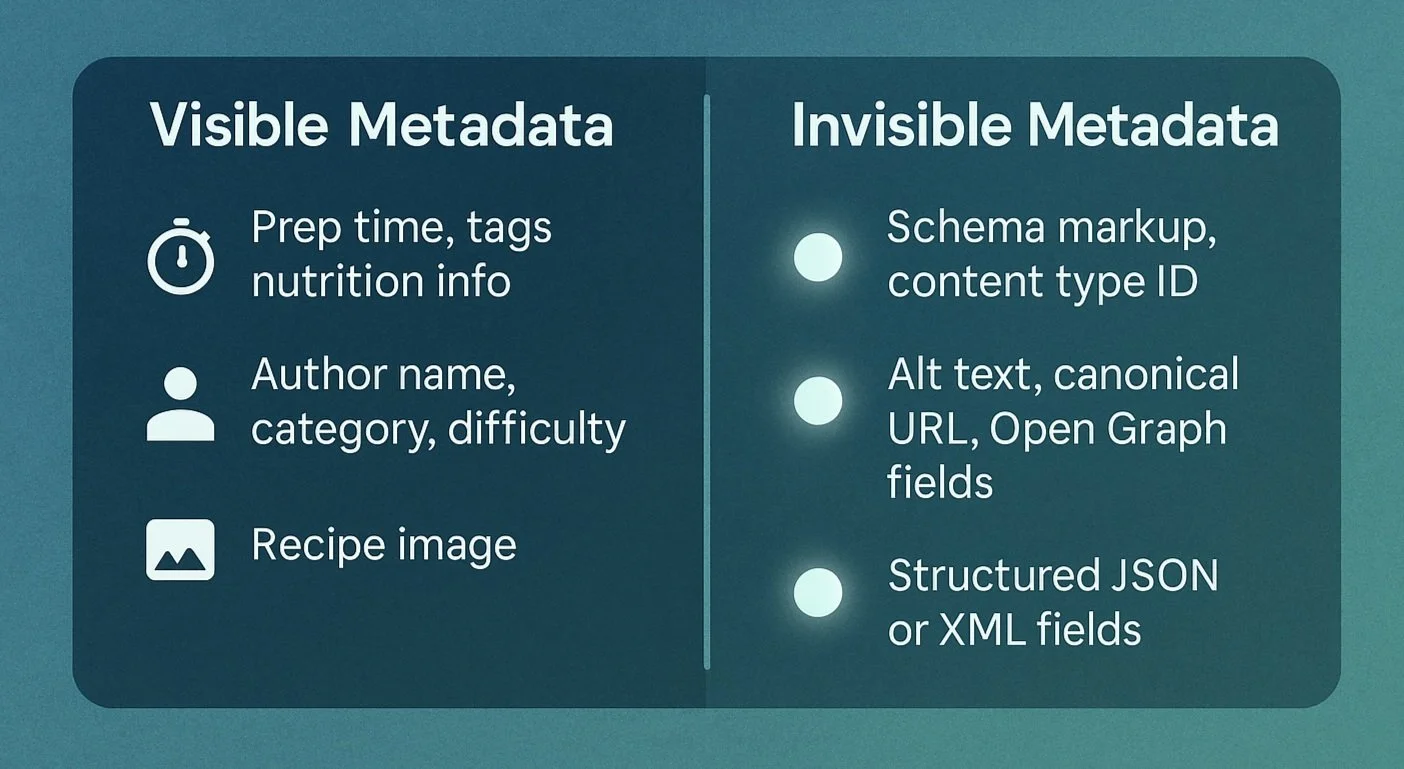
Visible vs. invisible metadata
Not all metadata is hidden. Some metadata is visible to people (prep time, servings, tags). But much of it is invisible—used behind the scenes to power discovery, previews, filters, and platform features.
A useful distinction
Visible metadata supports cooking. Invisible metadata supports distribution.
Visible fields help a reader decide if a recipe fits their night. Invisible fields help systems decide if the recipe fits a search query, a filter, or a recommendation feed. Both types work together.
How platforms use metadata
Whether you realize it or not, metadata powers how your recipe appears across the web—and how people find it. Here’s how four common surfaces rely on structured recipe data.
Search engines
Metadata influences whether your recipe appears as an enhanced result (with time, image, rating, and other details) or gets treated like a standard page. Structured markup helps systems understand that your content is a recipe and identifies the fields that matter.
If key fields are missing, the system has to guess. Guessing is not a strategy.
Visual discovery platforms
Platforms that support enhanced recipe formats typically look for structured recipe fields—ingredients, cook time, servings, and sometimes nutrition. When metadata is missing or inconsistent, content can be excluded from enhanced formats and filters.
Step-by-step cooking experiences
Step delivery requires instructions to be structured into individual steps. If instructions are written as one paragraph, systems can’t reliably deliver step-by-step guidance.
Recipe apps, meal planning, and shopping integrations
Recommendation engines rely on metadata to filter by diet, cuisine, meal type, and time. Grocery list builders rely on consistent quantities and units. When those fields are incomplete, recipes are harder to match to intent.
Metadata most food creators miss
Most creators fill out the basics. The fields below are commonly skipped—and they matter more than ever for discoverability and monetization.
1. Cuisine
Why it matters: powers cultural filtering and recommendation engines.
Examples: Haitian, Mediterranean, Tex-Mex.
A common issue: creators use cuisine like a casual tag instead of a consistent field. That creates fragmentation (“Caribbean” here, “Haitian” there, “West Indian” somewhere else) without a clear system.
2. Dietary tags
Why it matters: enables filtering for preferences (vegan, dairy-free, Whole30).
A common issue: inconsistent terminology. “Gluten free,” “GF,” and “gluten-free” become three separate signals instead of one.
3. Difficulty level
Helps beginner cooks find simpler recipes and supports filters used in many recipe experiences. Difficulty can be simple (easy / medium / advanced) as long as the rubric is consistent.
4. Alt text for images
Enhances accessibility and helps systems interpret what an image shows. Alt text is also a clean way to reinforce clarity without keyword stuffing.
5. Structured instructions
Should be broken into individual steps, not one paragraph. Structured steps enable step navigation, voice delivery, and better usability on mobile.
6. Yield, servings, and portion info
Powers meal planning and grocery list integrations. It also improves user trust: readers want to know what they’re getting.
What this adds up to
The “optional” fields are often the fields that unlock distribution
Many creators stop at the minimum required fields. Platforms don’t. If you want your content to be filtered, recommended, and reused, the fields that feel optional are frequently the ones that make the difference.
What happens when metadata is missing or inconsistent?
- No enhanced recipe results in search
- Lower visibility in platform discovery
- Weaker previews when sharing links
- Incompatibility with recipe platforms and shopping tools
- Poor accessibility for screen readers
- Limited monetization via licensing or integrations
Your content works on your blog, but not beyond it. That is the cost of weak metadata.
How to improve your metadata today
You don’t need to overhaul your entire site to strengthen metadata. Start with practical steps that reduce ambiguity and increase consistency.
1. Run a schema test
Use a structured data testing tool to see how your recipe data is being read. You’ll quickly spot missing fields and formatting errors.
2. Audit your tags and categories
Standardize terminology. If one recipe uses “30 minutes” and another uses “under 30 mins,” your taxonomy is splitting your data into separate buckets.
3. Choose a plugin or system that supports robust recipe fields
Tools can support structured data, but they can’t fill it in for you. Make a short list of fields you commit to completing for every recipe going forward.
4. Add alt text and clean file names
Use descriptive file names like vegan-lemon-bars.jpg instead of IMG1234.jpg. Make alt text match the visual: “Glazed lemon bars stacked on parchment paper.”
5. Document your metadata standards
Even a one-page “rules” doc helps. It keeps your tags consistent, makes publishing faster, and prevents drift as your archive grows.
Tools that can help
- Google Rich Results Test (https://search.google.com/test/rich-results)
- Schema.org Recipe Specification (https://schema.org/Recipe)
- WP Recipe Maker / Create by Mediavine (WordPress plugins)
- Cloud backup with XML exports (for metadata-safe content exports)
Related: If your blog disappeared tomorrow
Final takeaway: metadata is what makes your recipe usable
It’s not enough to write good recipes. Your recipes also need to be understandable to platforms, tools, and technologies. That’s what metadata does. It adds structure, clarity, and reusability to every piece of content you publish.
Think of metadata as the scaffolding behind discoverability. It doesn’t just help you get found—it helps you build a catalog that can travel across platforms and support new opportunities over time.
Blueberri Solutions
Reimagine what’s possible with your content
Blueberri helps food bloggers and food tech teams optimize recipes, streamline content workflows, and unlock new monetization opportunities.
- Fractional content leadership and consulting
- Actionable audits and strategy packages
- Weekly insights in the Blueberri Pi newsletter
Free to join. Services customized to fit your needs.
