
From agentive to agentic: How AI is changing the cooking experience (again)

What happens when the technology doesn’t just assist, it acts?
Until recently, most conversations about AI in food focused on agentive experiences, tools designed to help users cook more efficiently, suggest recipes based on what’s in the fridge, or read instructions aloud through voice assistants. This was the era of agentive content: structured data powering helpful, interactive features, always with the user in control.
But that’s already changing.
We’re now seeing a new model emerge, one where AI systems don’t just respond to input, they initiate it. These systems act on your behalf, adapting and executing tasks without being prompted.
And that shift is poised to reshape how we cook, how we shop, and how we create food content—again.
What is agentive content?
Agentive content is structured digital information designed to support tools that assist human decision-making, without acting independently. In food, this looks like:
Voice assistants that read instructions step-by-step
Meal planners that suggest recipes based on dietary filters
Apps that display prep time or nutrition from schema markup
The user remains in control. The tech simply supports.
What is agentic AI?
Agentic AI refers to autonomous systems that make decisions and take action with minimal user input. These tools:
Learn user behavior
Generate personalized outputs
Trigger actions like grocery orders, meal prep reminders, or recipe edits—without needing to be told
It’s a shift from assistive to active.
From helper to decision-maker: Understanding the shift
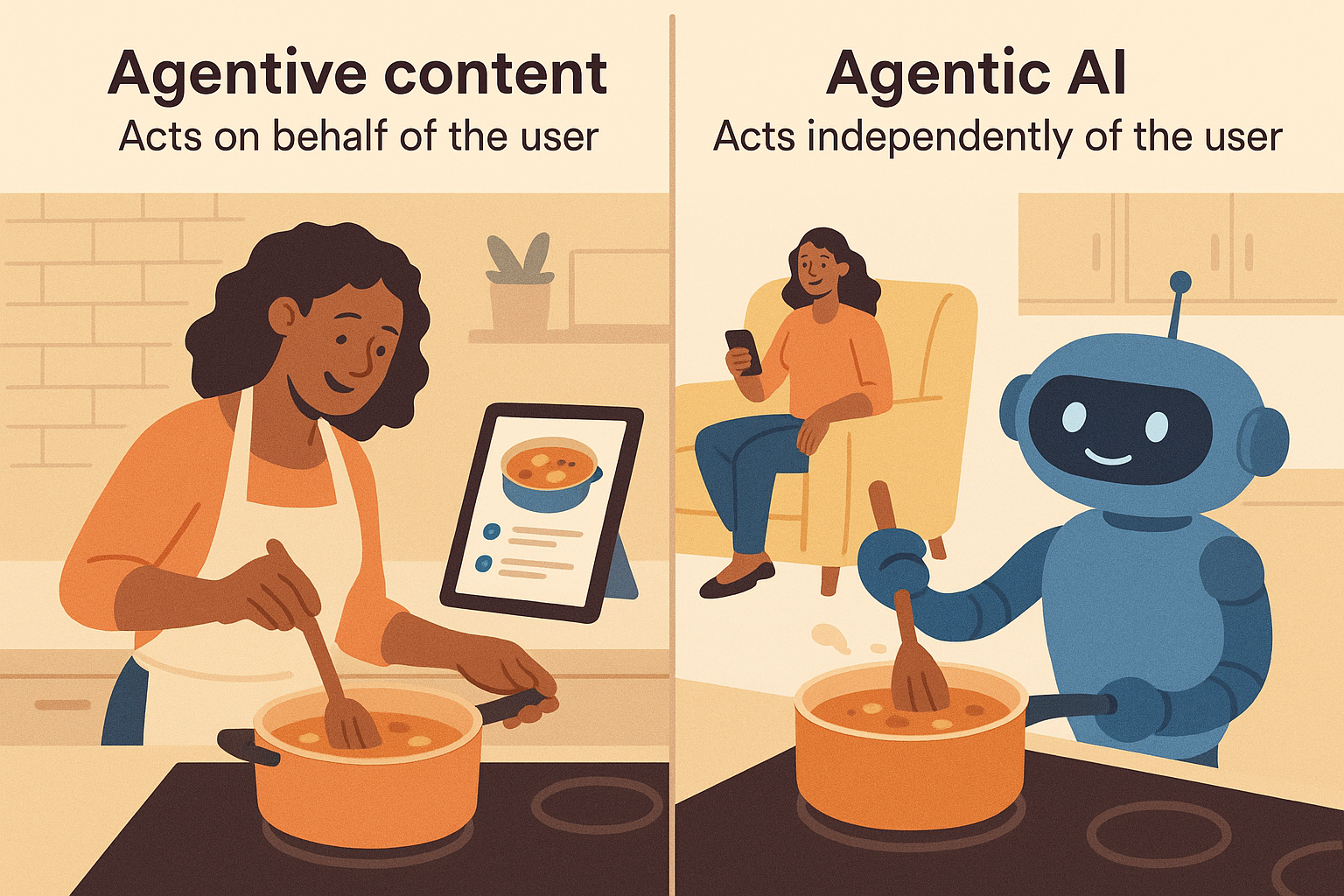
To understand where we’re going, it helps to look at where we started.
The agentive phase
In this stage, AI-powered systems supported tasks you were already doing:
Google Assistant reads recipes aloud
Pinterest recommended weeknight dinners
Grocery apps helped you build shopping lists from saved recipes
Smart ovens prompt you through preheat instructions
These systems depended on structured content, metadata, clean instruction steps, nutrition labels, and tags to work properly. But they were reactive. You gave the input, and they followed your lead.
The agentic phase
We’re now seeing AI shift into an initiator role:
Your kitchen display builds a dinner plan based on your calendar and fitness goals
A smart meal planner sends your grocery list straight to your preferred store
AI systems tweak recipes dynamically based on your ingredient availability and cooking preferences
Appliances, apps, and AI services collaborate behind the scenes to “run” your dinner without needing explicit instructions
These are agentic systems: capable of not just interpreting data, but acting on it in your absence.
Agentic AI in the kitchen: Real examples already emerging
This isn’t theoretical, it’s already here in early forms. A few key developments:
1. Smart kitchen assistants are getting proactive
Brands like Samsung and LG have integrated AI into their kitchen ecosystems. Their platforms:
Auto-sync with calendars and fitness trackers
Suggest meals based on user behavior and saved preferences
Preheat ovens, adjust cooking modes, and order groceries—sometimes without direct input
These systems work because they interpret structured recipe data and merge it with real-world context (e.g., time of day, device usage history, or dietary needs).
2. Meal planning platforms are becoming predictive
Tools like SideChef, Cooklist, and Mealime are evolving beyond static planning. They:
Learn user preferences over time
Auto-populate plans that balance variety and convenience
Integrate with smart kitchen devices and retailer APIs
Suggest recipes that are both taste-compatible and budget-conscious
Some are even training fine-tuned AI models on individual user data to create personalized meal generation agents.
3. AI agents are remixing recipes on the fly
Some AI platforms now allow:
Swapping ingredients intelligently (e.g., converting a recipe to dairy-free)
Scaling portions dynamically for batch cooking
Changing flavor profiles or cuisines mid-recipe
These modifications happen in real time, not as static “filtering” but through generative restructuring of the recipe itself.
Related: Agentive, Interoperable Content: How to Design Recipes for a Multi-Device World
Why this matters for recipe creators and food brands
For food creators, platforms, and product teams, this shift changes the game. You’re no longer just creating for readers. You’re creating for systems that act on your content, without human instruction in the loop.
That means your content must be:
Structured
If your content isn’t labeled clearly (ingredients, instructions, dietary tags, cook methods), agentic systems can’t process or remix it. Structure is non-negotiable.
Modular
You can’t just publish a blog post anymore. You need portable components– a step list, a recipe card, a nutrition table, and a shopping list that can be pulled and used separately.
Interoperable
Your content must work across multiple systems (apps, devices, platforms). This means using standard formats (like JSON or XML), clean tagging, and avoiding platform lock-in.
Related: How Structured Content Drives Recipe Discoverability & Monetization
From agentive to agentic: what content teams must shift
Let’s break this shift down into practical implications for content operations and team strategy.
The human side: Trust, transparency, and taste
As AI takes more action, new questions emerge:
Will users trust a machine to pick their meals?
How do creators retain voice and cultural integrity when recipes are remixed?
What does “authorship” mean when content is dynamically generated?
Agentic AI may be smart, but it must be trained on responsible content. That’s why your recipes, context, and structure still matter. AI may handle the mechanics, but creators define the soul.
What creators and content teams can do now
This shift doesn’t require you to be an engineer. But it does mean thinking differently about how your content is created and shared.
Start here:
Audit your recipe structure. Are you using schema markup? Are your ingredients and steps separated cleanly?
Adopt interoperable formats. Export your recipes in machine-readable formats like JSON or XML. Back up your content regularly.
Tag your content richly. Use consistent dietary, cuisine, prep method, and flavor profile tags. This enables better filtering and remixing.
Think in components. Can your recipe function if the introduction or imagery is removed? Can the steps stand alone?
Track emerging platforms. Explore how AI kitchen assistants, grocery services, or voice platforms are evolving—and where your content might fit.
Related: How Recipe Platforms Process and Use Your Content
Related: If Your Blog Disappeared Tomorrow: How to Protect and Future-Proof Your Recipes
A content framework for agentic platforms
Here’s a simple way to evaluate your readiness.

If you’re missing 2 or more, start with metadata and modular structure. Those are the foundations.
You’re not just writing recipes. You’re building systems.
Agentic AI is redefining food experiences, from planning to prep to plate. But the magic doesn’t come from the tools, it comes from how your content is built.
Recipes that are clean, structured, and portable will thrive across the next generation of food tech. Recipes that are static, bloated, or unstructured will be left behind.
This isn’t about replacing your creativity. It’s about future-proofing it.
Want to prepare your content for agentic systems and future food platforms?
Book a content strategy session.
Subscribe to Blueberri Pi for weekly insights on content modeling, metadata, and food-tech innovation.
